Percent-Risk Position Sizing: Size Trades by Stop Distance
Percent-risk position sizing ties trade size to stop distance, not gut feel. Learn how to set risk per trade, avoid oversizing, and apply it in a bot.
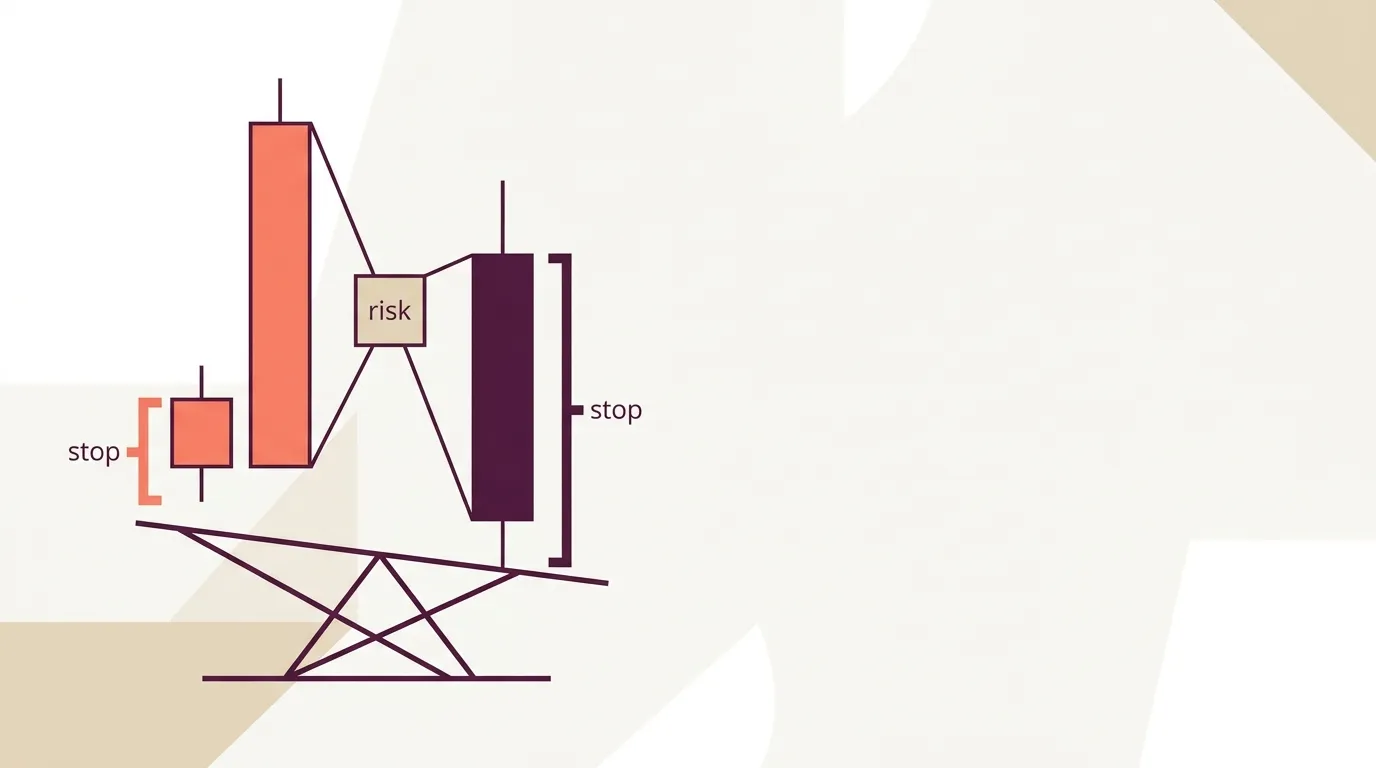
The rule in one line
Percent-risk position sizing means each trade risks the same small slice of your account — say 0.5% — and the distance to your stop determines how big the position is. Wide stop, smaller position. Tight stop, larger position. The loss if you're wrong stays roughly constant.
That's the whole idea. Most sizing mistakes come from doing it backwards: picking a size first, then bolting a stop on wherever it looks nice.
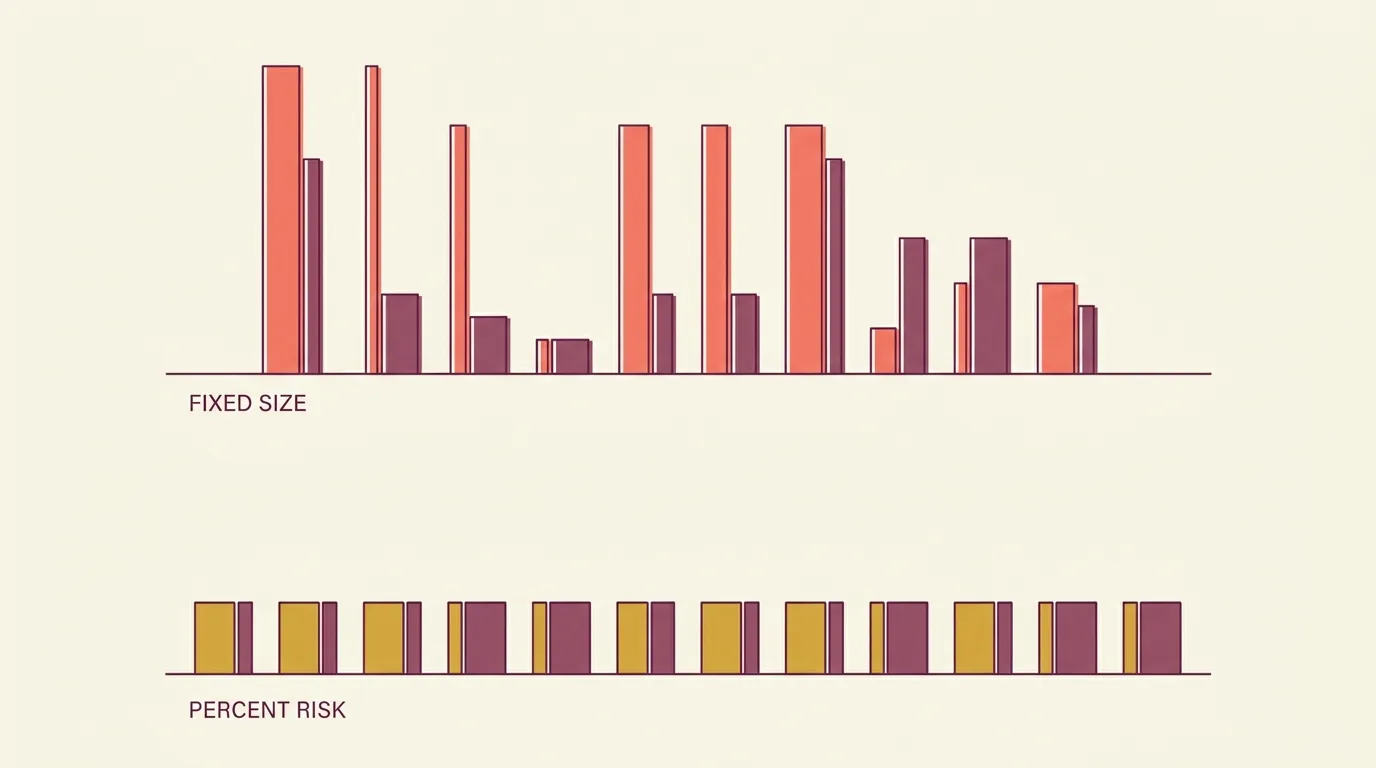
Why fixed size quietly breaks your risk
If you always buy the same quantity, your actual risk swings wildly with volatility and stop placement.
With fixed size, trade B hurts four times more than trade A even though both were "one trade." A cluster of wide-stop losers can then produce a drawdown far bigger than your loss count suggests — and .
Percent-risk sizing normalises that. Ten losers in a row cost roughly ten units of risk, whatever the market did.
Your position size isn't a conviction dial. It's the output of a stop distance and a fixed risk budget.
Choosing your risk per trade
There is no universally correct number, but the trade-offs are predictable:
- 0.25%–0.5% — conservative. Suits high-frequency bots, correlated portfolios, or anything newly deployed.
- 0.5%–1% — the common working range for a single tested strategy.
- Above 2% — a short losing streak becomes an account-level problem. Rare in systematic trading for good reason.
Three factors should pull your number down:
- Multiple bots running at once. If three bots can be long correlated crypto pairs simultaneously, your real risk is closer to the sum, not the individual figure.
- Leverage. On futures, margin lets a "small" position carry a large notional. Size from your stop distance, not from available margin.
- Uncertainty about the edge. A strategy with a short live track record deserves less risk than one you've watched for months.
Percent risk assumes your stop actually fills near its level. Gaps, weekend moves in stocks, and thin-liquidity crypto candles can produce losses larger than planned. Treat your risk figure as a target, not a guarantee.
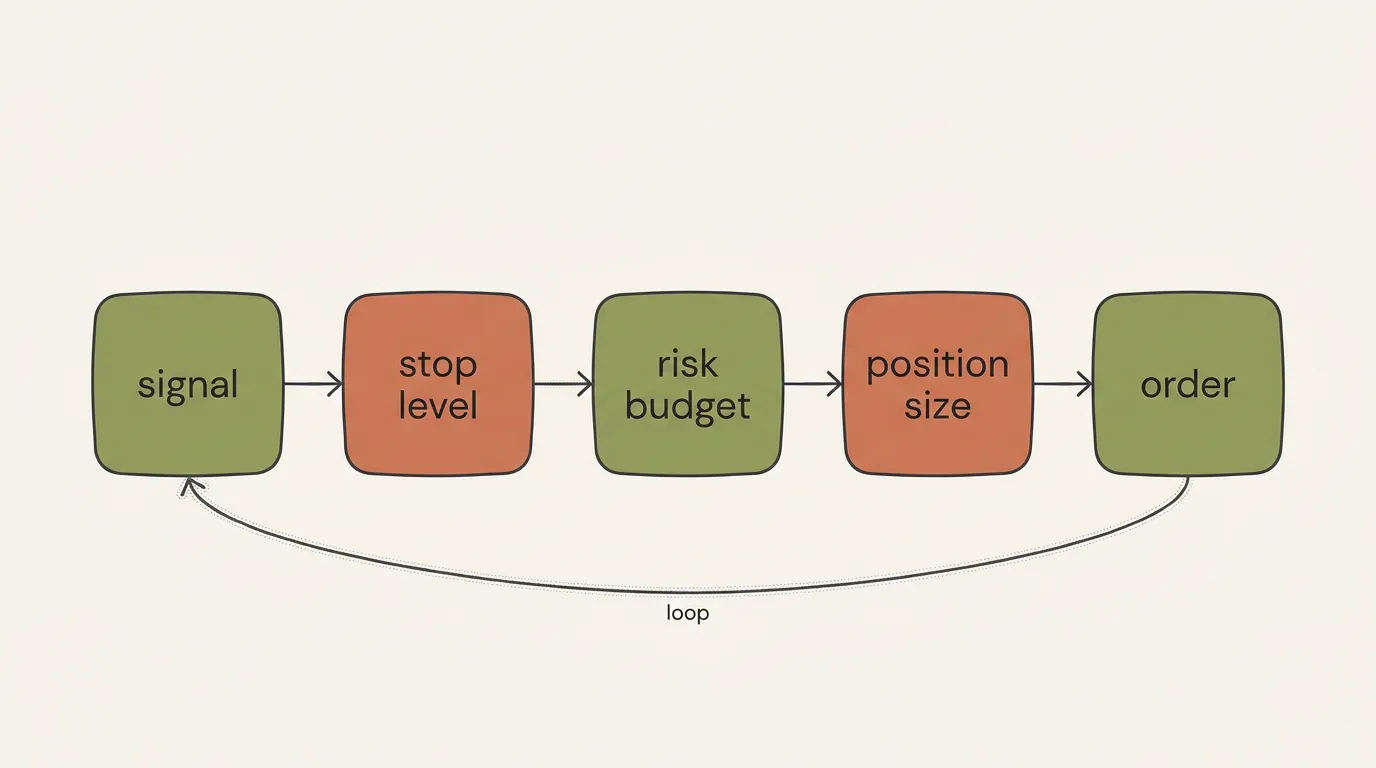
Setting the stop distance first
Since size falls out of the stop, the stop has to be meaningful — placed where your trade idea is invalidated, not at a round number that feels tolerable.
Two common approaches:
- Structure-based: below the swing low, beyond the retest level, outside the range. Logical, but distance varies a lot trade to trade.
- Volatility-based: a multiple of recent range, typically using the . This adapts automatically when a market gets choppier, which pairs naturally with percent-risk sizing.
Whichever you use, the sequence never changes: signal → stop level → risk budget → position size → order.
Putting it into a bot
This is where automation earns its keep. Recalculating size on every signal is exactly the kind of arithmetic humans skip when they're in a hurry or annoyed after a loss — the shows up most clearly in sizing.
On algomax you simply describe it in plain language — "risk 0.5% of account per trade, stop at two times ATR below entry, take profit at three times the risk" — and the AI assistant turns that into a ready-to-run bot. No formulas to write. Then and check two things:
- Does average loss per losing trade actually sit near your risk budget?
- Does minimum position size on your venue force rounding that distorts small trades?
If minimum order size means a 0.5% risk can't be expressed on a given symbol, you either trade a different symbol or accept a larger effective risk — don't pretend the number holds.
Key takeaways
- Percent-risk sizing fixes the loss and lets the stop distance set the size, not the other way round.
- Most retail systematic traders live in the 0.25%–1% per trade range; correlation and leverage argue for the low end.
- Place the stop where the idea is invalidated, then size — never in reverse.
- Verify in backtest that realised losses match the intended budget, and account for venue minimum order sizes.
Frequently asked questions
How much should I risk per trade?
There is no universally correct figure, but most systematic retail traders work in the 0.25% to 1% range per trade. Correlated positions, leverage, and an unproven strategy are all reasons to sit at the lower end.
Does percent-risk sizing work with leverage?
Yes, but the risk calculation must come from your stop distance and account equity, not from how much margin the venue makes available. Leverage changes notional exposure, not how much you should be willing to lose on a single idea.
What if my stop is very tight?
A tight stop mathematically allows a larger position, which can push you into oversized notional exposure and higher fee drag. Cap position size at an absolute ceiling as well as a risk percentage so one very tight stop can't dominate your book.
Can percent-risk sizing guarantee my maximum loss?
No. It targets a loss level, but gaps, weekend moves and thin liquidity can cause fills well beyond your stop price. Treat the number as a planning target, not a hard guarantee.
How do I set this up without coding?
On algomax you describe the rule conversationally — for example, risking a fixed percentage per trade with a volatility-based stop — and the AI assistant turns that description into a ready-to-run bot you can backtest and then deploy through your own broker keys.