Mean Reversion Regime Filter: Skip the Falling Knives
A mean reversion regime filter tells your bot when dips bounce and when they keep falling. Practical filters, thresholds and pitfalls for no-code bots.
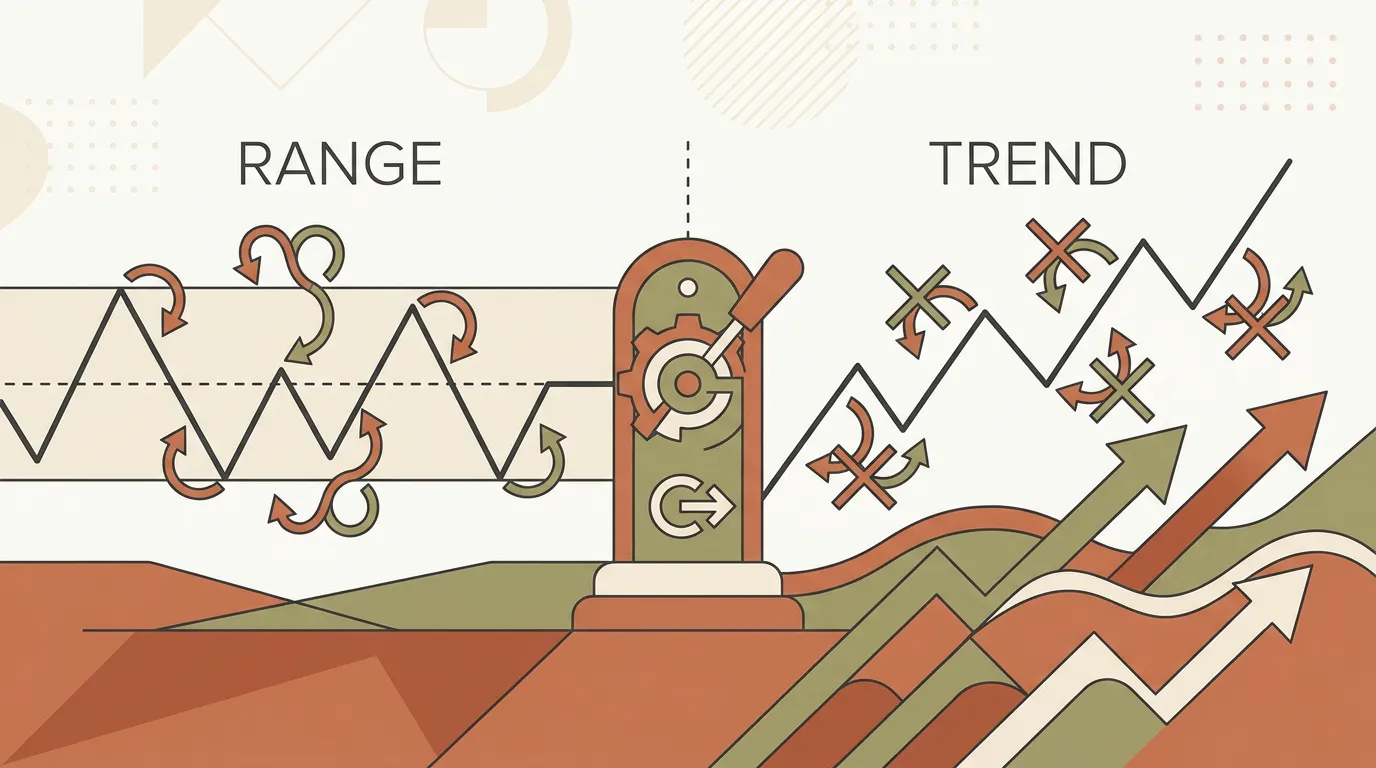
Why oversold alone is not an edge
A mean reversion bot buys weakness expecting a snap back. The problem: the same oversold reading means "cheap" in a range and "get out of the way" in a downtrend. Without a regime filter, your bot happily catches every falling knife on the way down.
A regime filter is a second condition, evaluated before the entry signal, that answers one question: is this market currently ranging or trending? If the answer is trending, the fade is skipped.
Mean reversion does not lose money because the entry trigger is wrong. It loses money because the trigger fires in the wrong environment.
Four filters that actually separate range from trend
You do not need all four. Pick one, maybe two, and understand what each one measures.
- Long moving average slope. Measure whether a slow average (for example a 200-period line) is rising, falling or flat over the last N bars. Only take long fades when the slope is flat or up. Simple, robust, slow to adapt.
- Price distance from the mean, in volatility units. If price is more than a few average true range multiples below the mean and still expanding, that is trend, not stretch. The gives you the volatility yardstick.
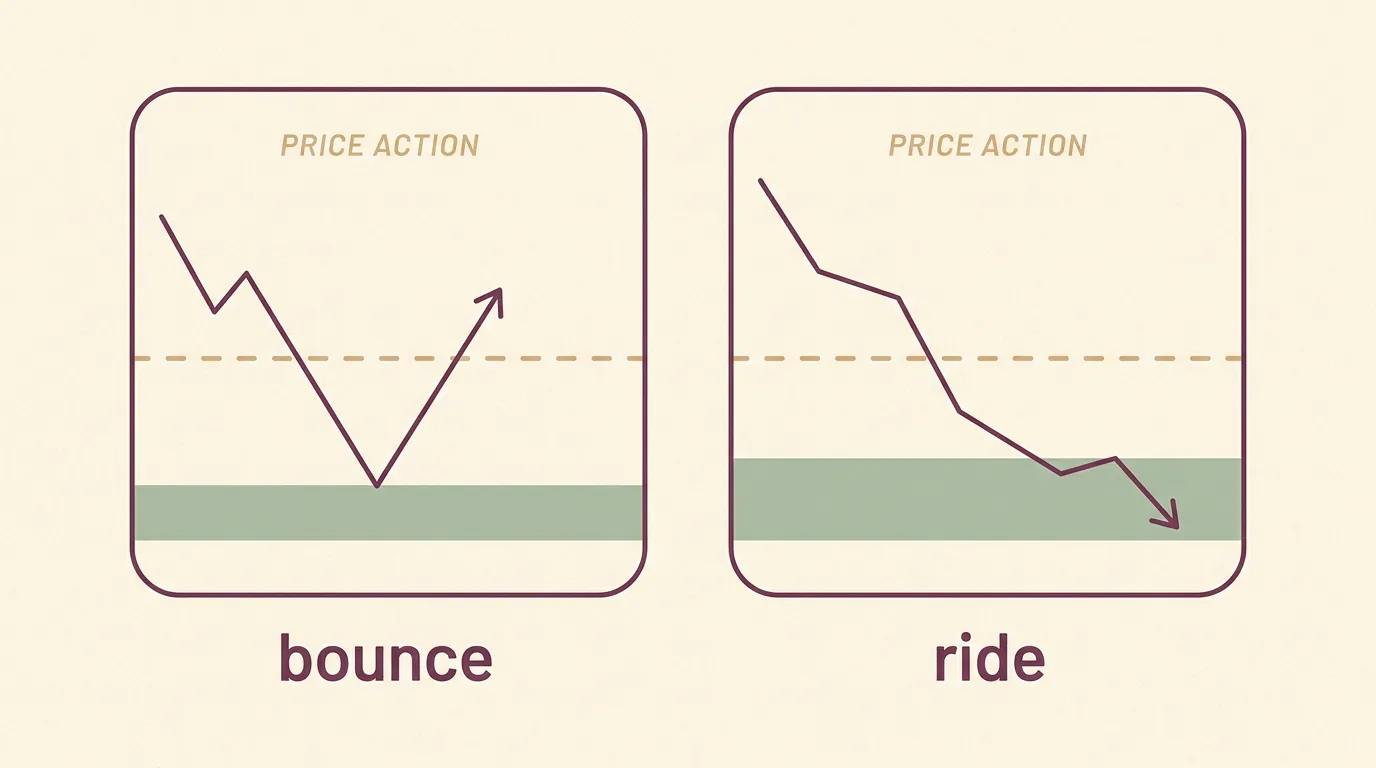
- Band behaviour. In a range, band touches are followed by a return to the middle. In a trend, price rides the band. Requiring price to close back inside the band before entry filters out most rides.
- Higher timeframe agreement. Fade 15-minute dips only when the daily structure is neutral or supportive. Costs you signals; removes the worst ones.
Test the exact same entry rule with the filter on and off, over the same period. If the filter does not measurably reduce your worst losing streak, it is decoration, not risk control.
Thresholds: how strict should the gate be?
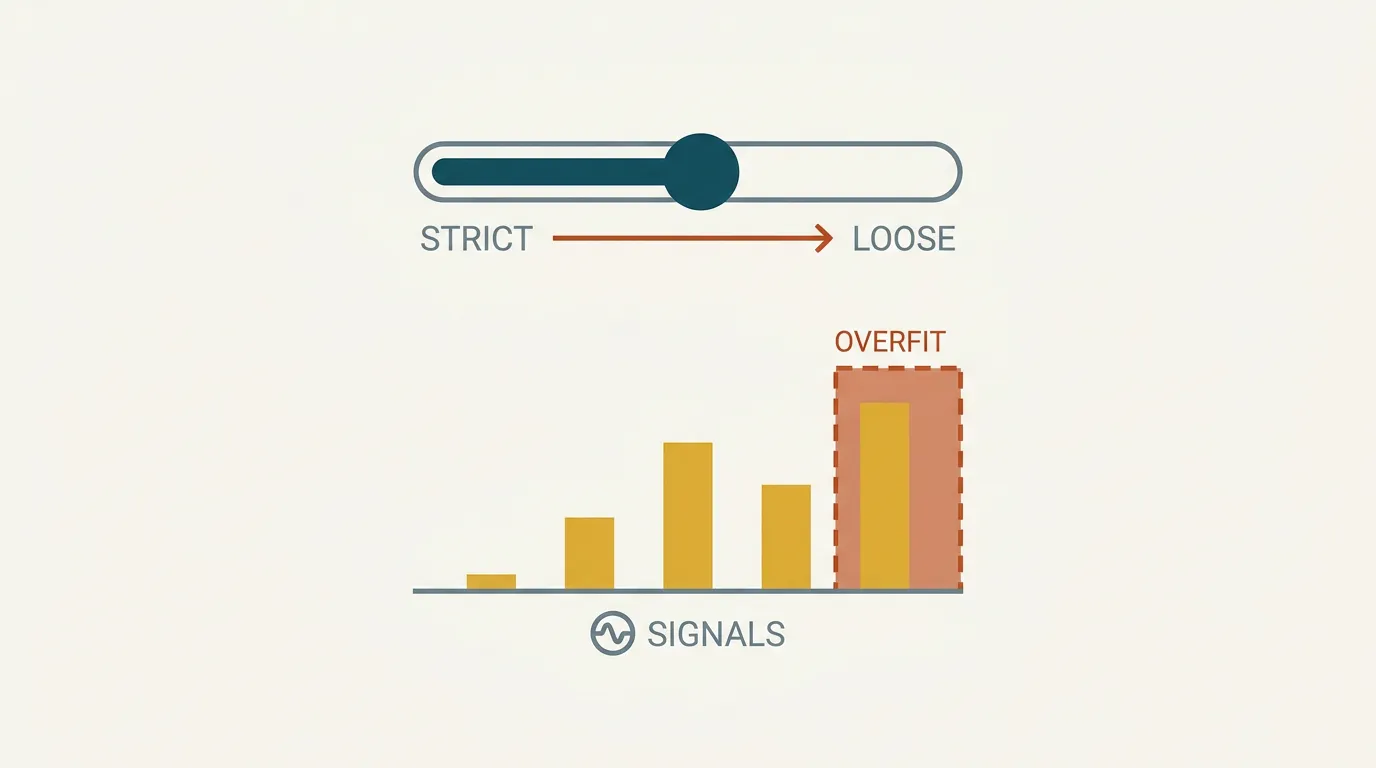
Every filter has a knob, and the knob is where overfitting hides. Practical starting points:
- Slope window: compare the slow average now versus roughly 20 bars ago. Shorter windows flip regimes constantly.
- Flat tolerance: define "flat" as a slope smaller than some fraction of ATR, not zero. Pure zero almost never happens.
- Signal budget: if the filter removes more than about 70% of your entries, you have probably tuned it to the backtest rather than to market structure.
Confirm any threshold on data you did not tune it on. That is what is for, and mean reversion systems are unusually easy to overfit because the win rate looks high right up until one trend wipes out fifty small wins.
Building it as a plain-language rule
On algomax you describe both layers in conversation, in your own language, and the assistant turns that into a ready-to-run bot. Something like: only look for long entries when the 200-period average has not fallen over the last 20 bars; then buy when price closes back inside the lower band; exit at the middle band or after a fixed stop below the entry swing.
Two things to add before going live:
- A hard stop. A regime filter reduces bad entries; it does not remove them. Mean reversion trades need a defined loss point, sized with so one broken range does not dominate the account.
- A daily loss cap. Reversion bots can fire repeatedly into the same collapsing move. A stops the bleeding while you review.
A filter that uses the closing value of the current, still-forming bar will look brilliant in a backtest and disappoint live. Evaluate regime on completed bars only.
Key takeaways
- Oversold readings are context-dependent; the regime filter supplies the context.
- Start with one filter (slope, ATR distance, band re-entry or higher timeframe), not a stack of four.
- Judge a filter by how much it shrinks the worst losing streak, not by how much it lifts total return.
- Keep the stop and the daily loss cap regardless; filters shift odds, they do not remove risk.
Frequently asked questions
What is a regime filter in a mean reversion strategy?
It is a condition checked before the entry trigger that classifies the market as ranging or trending. Fades are only taken in the ranging state, which keeps the bot out of the strong directional moves that break reversion logic.
Which regime filter is best for a beginner?
A slow moving average slope is the easiest to reason about: only fade dips when the long average is flat or rising. It is slow to react but hard to overfit compared with more elaborate combinations.
Does a regime filter guarantee I avoid falling knives?
No. It reduces how often the bot enters during sustained declines, but slow filters lag at regime turns and no filter removes risk. You still need a stop loss and sensible position sizing.
How do I know my filter is not overfitted?
Tune it on one slice of history and confirm it on a separate slice you never touched during tuning. If the improvement disappears out of sample, or the filter removes almost all your trades, it is curve fitting.
Can I build this without writing code?
Yes. On algomax you describe the filter and the entry rule in plain conversational language, in your own language, and the assistant turns the description into a bot you can backtest and then run through your own broker keys.