Market Hours: Why 24/7 vs Fixed Sessions Shapes Bots
Market hours are a core factor in choosing a market to automate. Compare crypto's 24/7 clock, forex's session cycle, and stock hours for trading bots.
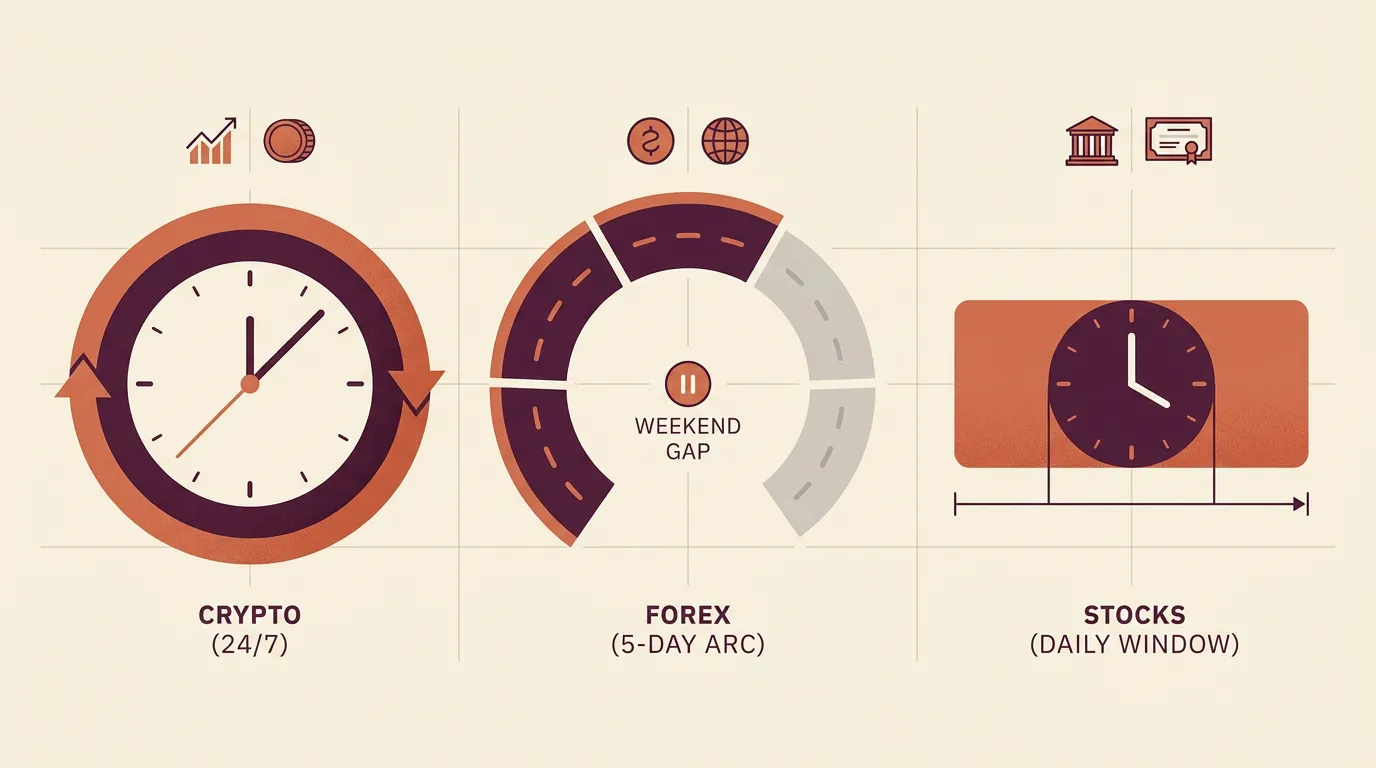
Trading hours are a design decision, not a detail
When people compare crypto, stocks, and forex, they focus on volatility or fees. But the operating hours of a market quietly shape everything your bot does — when it enters, how gaps hurt you, and how much you need to babysit it. Pick a market whose clock matches how much you want a bot to run unattended.
Here's how the three supported venues differ.
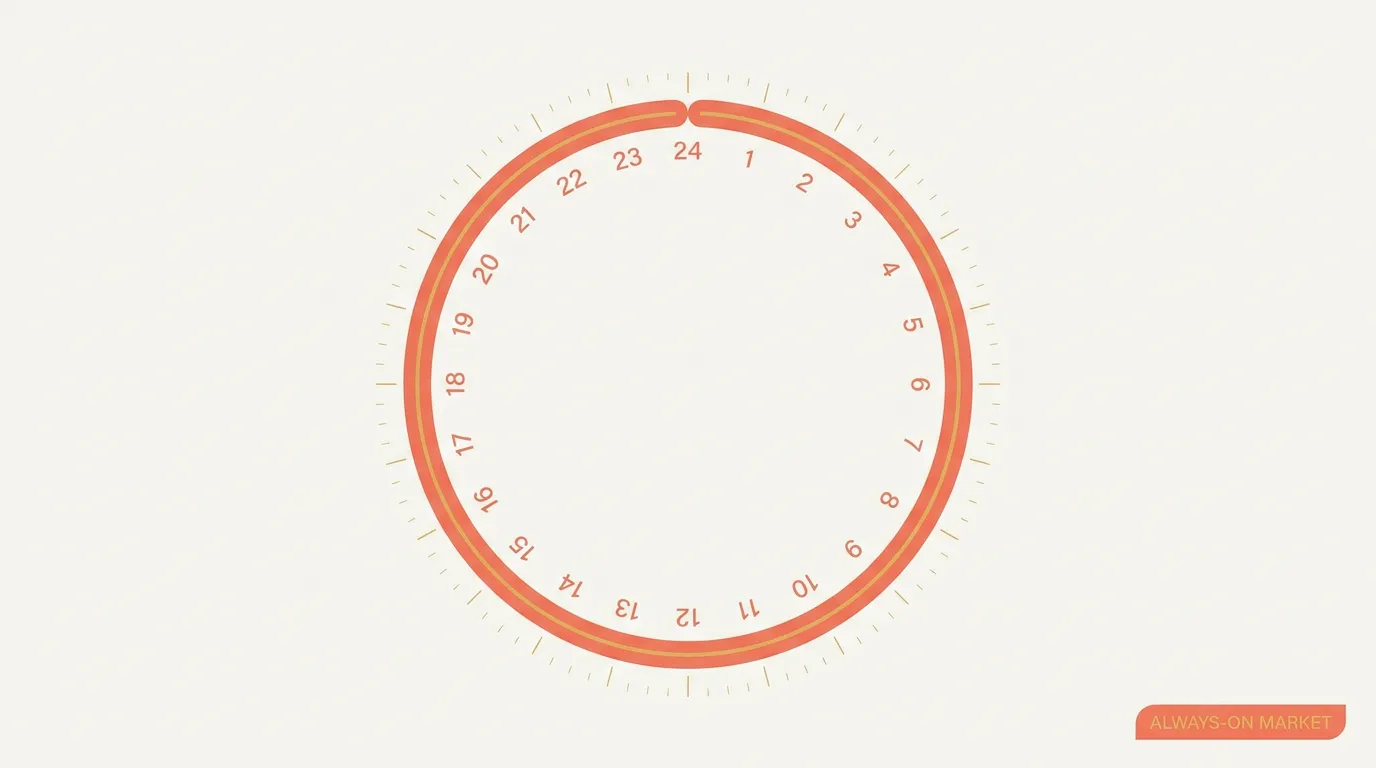
Crypto: the always-on clock
Crypto trades around the clock, every day. For a bot, that's a genuine advantage: no session opens to miss, no overnight gap where price jumps while you're flat, and continuous data for indicators to work with.
The trade-off is that you also never get a natural break. Bad news at 3 a.m. moves the market, and your bot is live for it. That makes automation almost mandatory rather than optional — and it makes solid more important, since there's no closing bell to force a pause.
Even in a 24/7 market, you can tell a bot to only act during hours you understand well. "Always open" doesn't mean "always trading" is smart.
Forex: a weekly cycle with seams
Forex runs roughly 24 hours, five days a week, structured into overlapping regional sessions. Liquidity and volatility shift as London, New York, and Asia hand off to each other — so when your bot trades matters as much as what it trades.
Two things to plan for:
- The weekend close. The market shuts Friday and reopens Sunday evening. Price can gap over the weekend, so positions held across it carry gap risk.
- Session timing. A breakout strategy behaves very differently during a quiet Asian session than during the London–New York overlap. Matching your logic to the right window is a real edge; see .
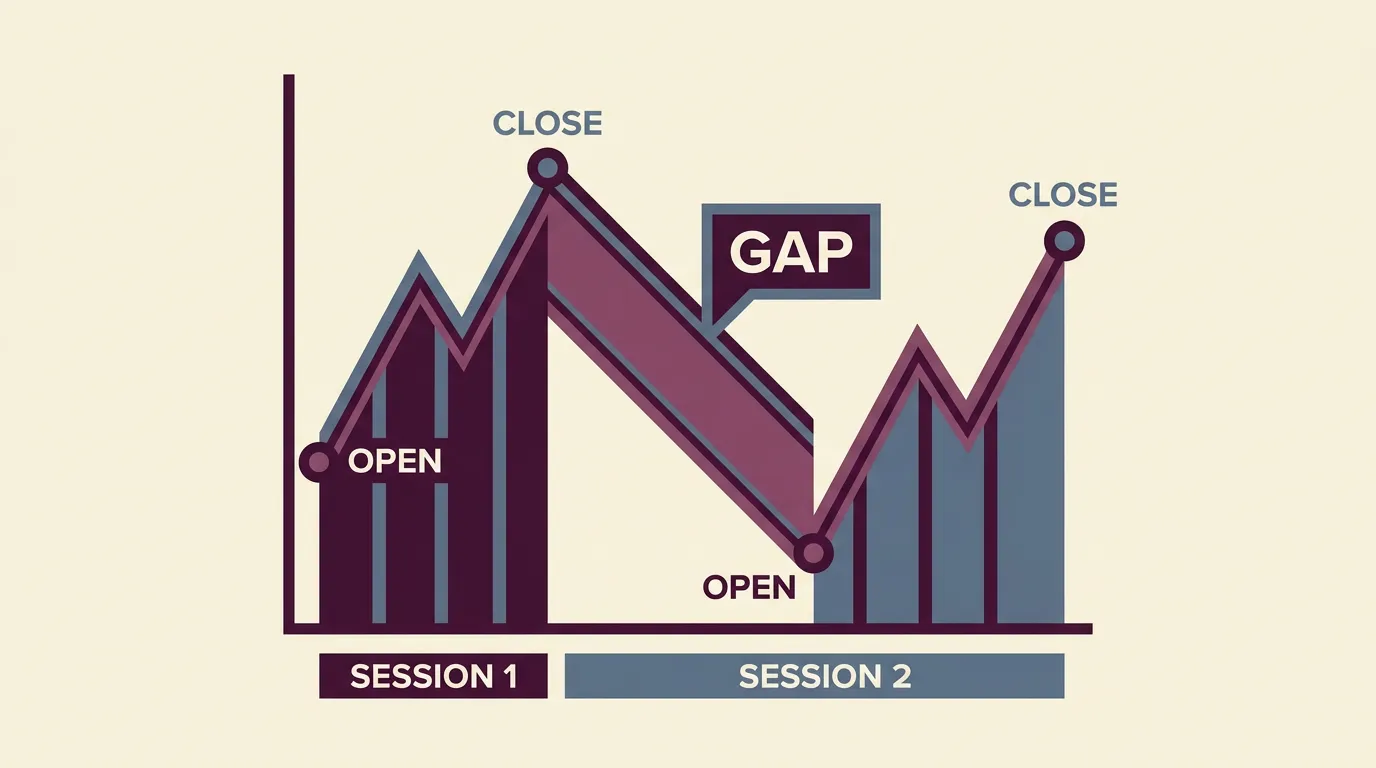
Stocks: a short, gappy window
US stocks trade a regular session of about six and a half hours, plus limited pre- and post-market windows. That short window has consequences:
- Overnight and weekend gaps are the norm. Earnings and news land while the market is closed, so a stock can open far from yesterday's close — stops don't protect you across a gap.
- Extended hours are thinner. Pre- and post-market trading exists but comes with wider spreads and less liquidity, which bots must handle carefully — more in .
The upside: a fixed session gives your bot a clean start and end each day, which suits strategies built around intraday patterns like an opening range.
Match the clock to your style
There's no "best" schedule — only the one that fits your strategy and your life.
- Want a bot that runs continuously and don't mind constant exposure? Crypto fits.
- Prefer defined sessions and a weekend off, with a rhythm to trade around? Forex works.
- Building around daily opens, closes, and intraday structure? Stocks suit that.
On algomax you — including when it should and shouldn't trade — and the AI turns it into a ready-to-run bot on your connected broker. You can to see how the market's hours actually affect results.
Key takeaways
- Market hours shape gap risk, babysitting, and entry timing — treat them as a core selection factor.
- Crypto is 24/7: continuous data, no gaps, but constant exposure.
- Forex is 24/5: session cycles matter, and weekends carry gap risk.
- Stocks trade a short window with frequent overnight gaps — good for intraday structure.
Frequently asked questions
Which market's hours are best for a beginner running a bot?
There's no universal best. Crypto's 24/7 clock means automation does the watching for you, but you carry constant exposure. Forex and stocks give natural breaks, which some beginners find easier to manage. Match the schedule to how hands-off you want to be.
Do I have to keep my bot running all day?
No. Even in a 24/7 market you can restrict a bot to specific hours or sessions you understand well. Limiting when it trades is often smarter than letting it act around the clock.
What is gap risk and which markets have it?
Gap risk is when price jumps between a market's close and its next open, skipping over your stop level. Stocks have overnight and weekend gaps, forex has weekend gaps, and continuously-traded crypto has minimal gap risk.
Can one strategy run across crypto, forex, and stocks?
The same logic can be described once, but each venue's hours, liquidity, and instruments differ, so behaviour and results will vary. Backtest each market separately rather than assuming a strategy transfers cleanly.