Max Daily Loss Limit: The Circuit Breaker Every Bot Needs
A max daily loss limit is the one risk rule that stops a bad day becoming a blown account. Here's how to set one for your trading bot and why it matters.
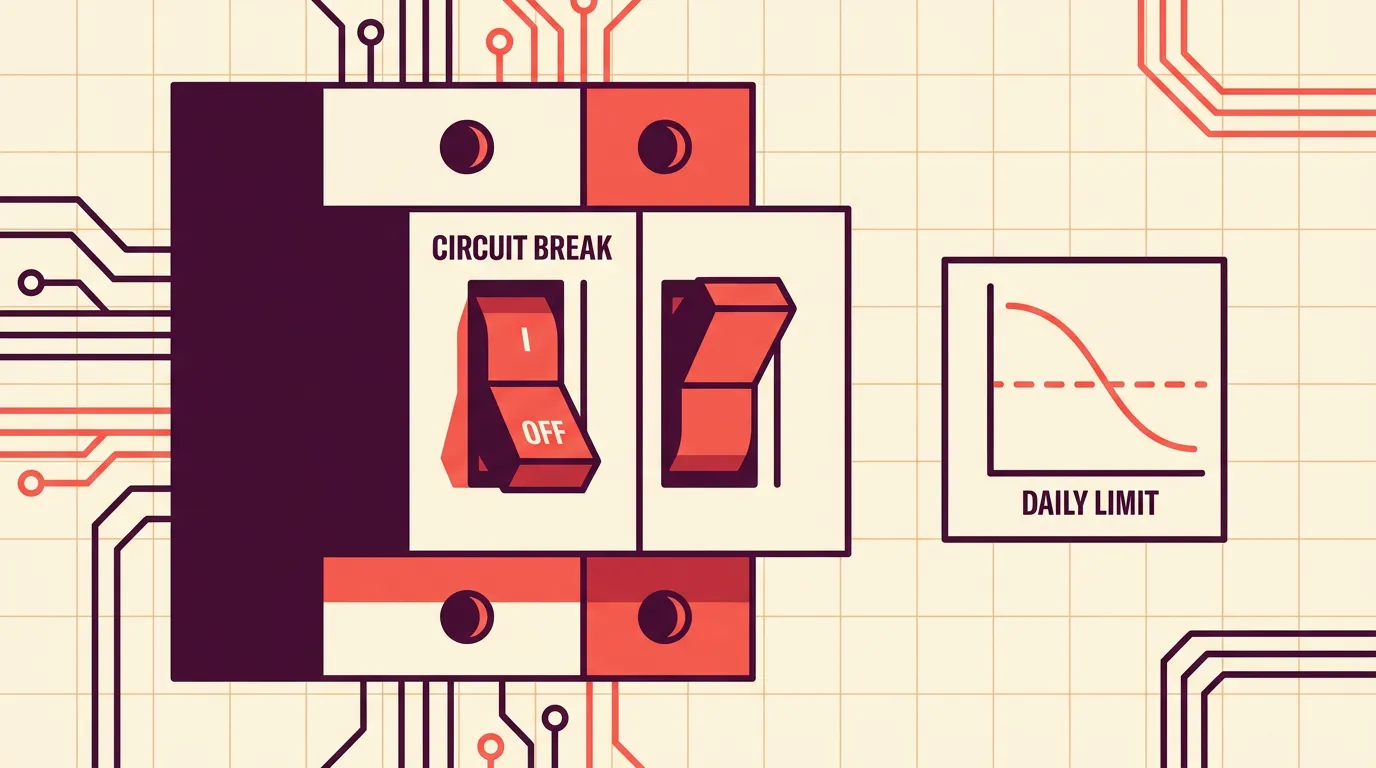
What a max daily loss limit actually does
A max daily loss limit is a hard rule that halts your bot once its losses for the day hit a set threshold. Hit the number, the bot stops opening new trades and stays off until the next session resets. That's it — a circuit breaker, not a strategy tweak.
Why does a bot need one when a human doesn't? Because a human eventually walks away. A bot will happily take the same losing setup 40 times in a choppy, news-driven market. The daily loss limit is the discipline you can't rely on yourself to enforce at 3 a.m.
A single bad day shouldn't be able to undo a month of good ones. The daily loss cap exists to make sure it can't.
How to set the number
Express the limit as a percentage of account equity, not a dollar amount — that way it scales as your account grows or shrinks. A common starting range is 1–3% of equity per day, though the right figure depends on your strategy's normal loss pattern.
Work backwards from your per-trade risk:
The point isn't the exact number — it's that your daily cap should absorb a normal losing streak without tripping, but stop you well before a catastrophic one. If two average losses trip the breaker, it's too tight and you'll be offline constantly. If it takes fifteen, it isn't protecting anything.
Set the limit based on your backtest's typical worst day, not its best. Look at the drawdown distribution, not just the headline return.
Daily loss vs the other guardrails
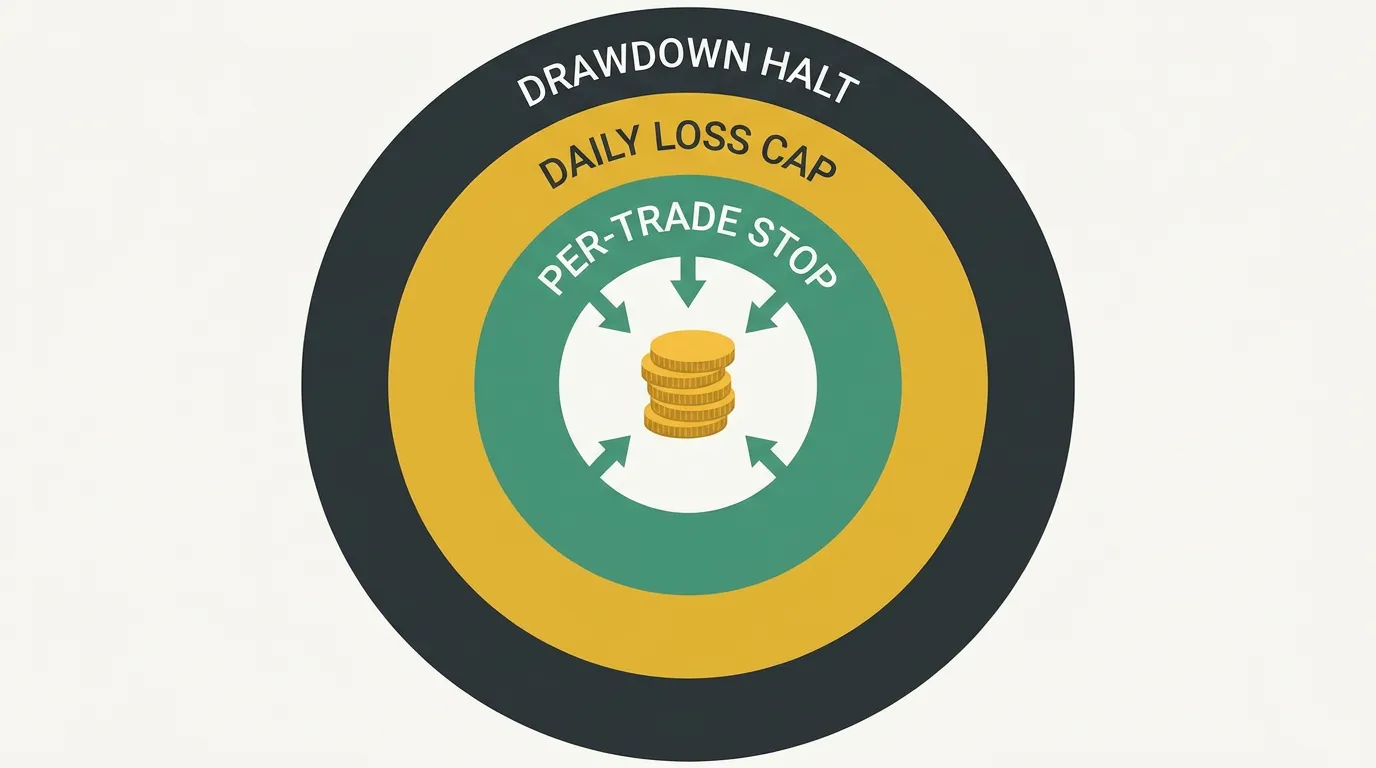
A daily cap is one layer. It works best alongside limits that operate on different timescales and dimensions:
- Per-trade stop loss — caps a single position. Often sized with volatility using the .
- Max daily loss — caps a single session across all trades.
- Max open exposure — caps how much capital is at risk at once.
- Max drawdown halt — caps the peak-to-trough decline over the whole run, not just today.
Think of them as nested. The stop protects a trade, the daily cap protects a day, the drawdown halt protects the account. A bot with only stops can still bleed out through sheer trade frequency — which is exactly the gap the daily limit fills.
Getting it right in practice
Three mistakes trip people up:
- Setting it too tight. A cap that fires on any two-loss cluster turns your bot off during the exact conditions it was built to trade. Give it room to breathe.
- Counting the wrong thing. Decide upfront whether the limit counts realized losses only or includes open, unrealized drawdown. Including unrealized is stricter and reacts faster to a fast move.
- Never testing it. A loss limit is a rule like any other — it belongs in your so you can see how often it would have triggered and whether it helped or just clipped good runs.
On a no-code platform like algomax, you don't wire any of this up by hand. You describe the rule in plain language — "stop trading for the day if I'm down 2%" — and the AI builds it into the bot's logic alongside the strategy. The same conversation that defines your entries defines your safety rails, and you can the same way you describe a signal.
A daily loss limit reduces the size of bad days — it does not guarantee profits or prevent losses. Trading is risky, and no risk control changes that.
Key takeaways
- A max daily loss limit halts your bot after a set loss for the session, then resets next day.
- Size it as 1–3% of equity, tuned so a normal losing streak won't trip it but a catastrophic one will.
- Pair it with per-trade stops, exposure caps, and a drawdown halt — each guards a different timescale.
- Backtest the limit itself and decide whether it counts realized or unrealized losses.
Frequently asked questions
What is a good max daily loss limit for a trading bot?
A common starting range is 1–3% of account equity per day, expressed as a percentage so it scales with your balance. The right figure depends on your per-trade risk and normal losing streaks — it should absorb an average bad run without tripping but stop you before a catastrophic one.
Should the daily loss limit count unrealized losses too?
You can set it either way. Counting only realized losses is more forgiving and reacts after positions close, while including open unrealized drawdown is stricter and reacts faster during a sharp move. Decide upfront so the behavior matches your risk tolerance.
What happens when the bot hits its daily loss limit?
It stops opening new trades for the rest of the session and stays offline until the limit resets, typically at the start of the next trading day. Existing positions are usually still governed by their own stop losses.
Is a daily loss limit enough on its own?
No. It only caps a single session. Pair it with per-trade stop losses, a maximum open-exposure limit, and an overall drawdown halt so each guardrail protects a different timescale.
Do I need to code a daily loss limit on algomax?
No. algomax is fully no-code — you describe the rule in plain language, such as stopping for the day after a 2% loss, and the AI builds it into your bot alongside the strategy.