Grid Trading Bounds: Where to Stop When Price Breaks Out
Grid trading bounds decide whether a range bot survives a breakout. How to set upper and lower limits, pick an edge rule, and place a stop that pays.
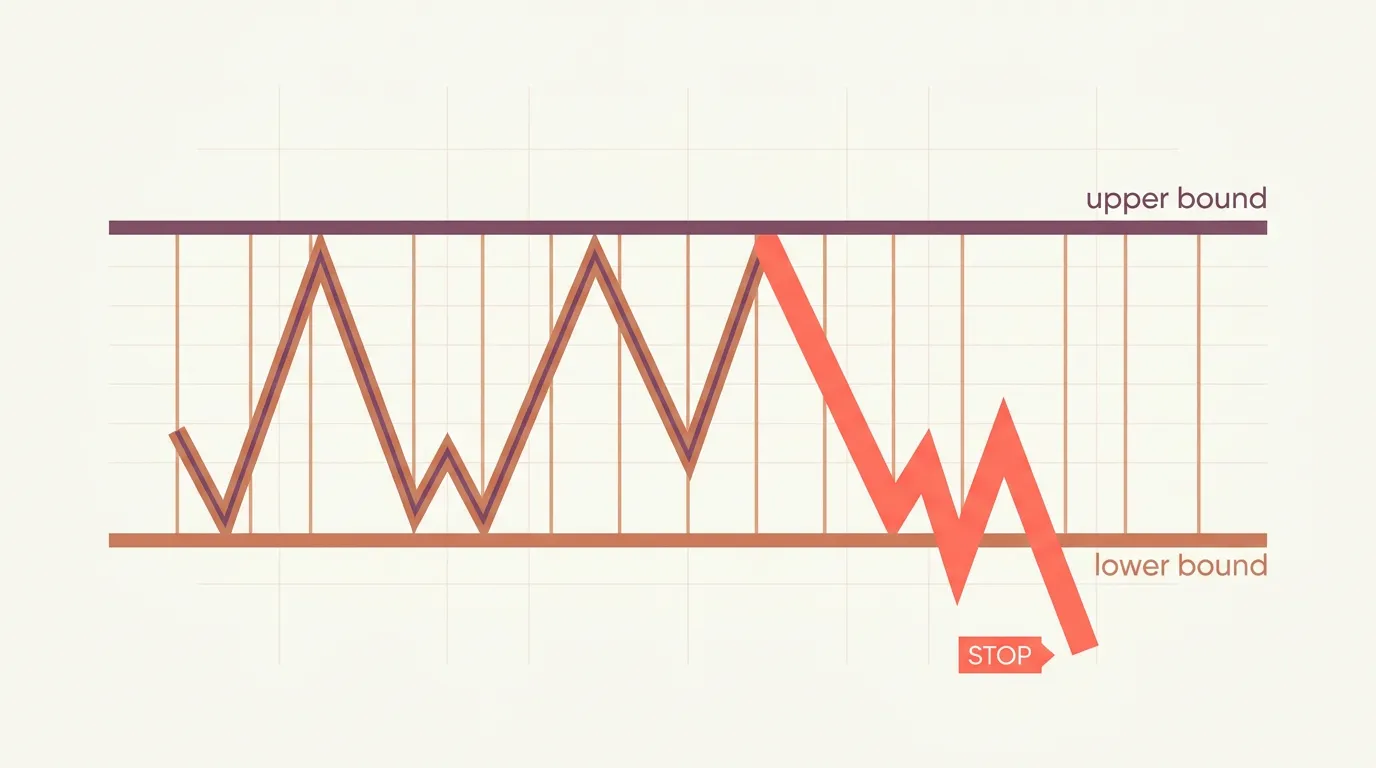
The one risk that defines grid trading
A grid bot makes small, frequent profits while price oscillates inside a range. It loses when price leaves that range and keeps going. Everything about grid bounds comes down to that single asymmetry: inside the range you earn, outside it you bleed.
So the real question is not "where do I put my top and bottom lines?" but "what happens the moment price touches them?" Pick the exit rule first, then pick the bounds.
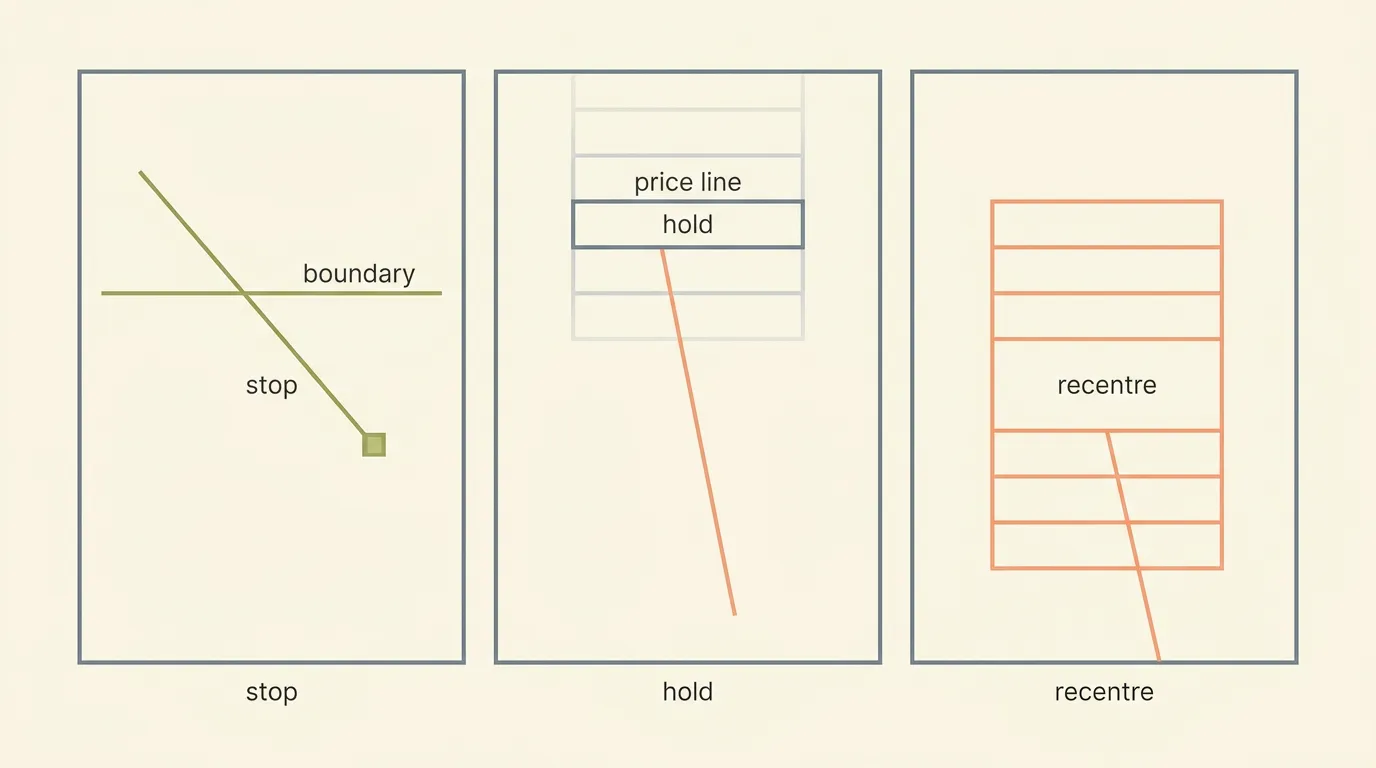
Three ways to end a grid
Every grid needs a defined behaviour at the edges. There are only three honest options, and each has a different pain profile.
Most blowups come from quietly choosing option two without admitting it. A grid without a stop is a bet that the range will come back, and on a trending asset that bet can stay wrong for months. If you are not willing to hold the inventory indefinitely, you need a hard stop, and the explains why loose stops get expensive fast.
A grid bot without a defined exit is not a range strategy. It is an unhedged accumulation plan wearing a range strategy costume.
Setting bounds from volatility, not from hope
Round numbers and recent wicks are poor bounds. Two methods are more defensible.
- Volatility-anchored bounds. Measure average true range on your trading timeframe and place bounds a multiple of ATR above and below the range midpoint. Wider ATR multiples mean fewer edge breaches but more capital tied up per level. The gives you a scale that adapts to the instrument instead of your gut.
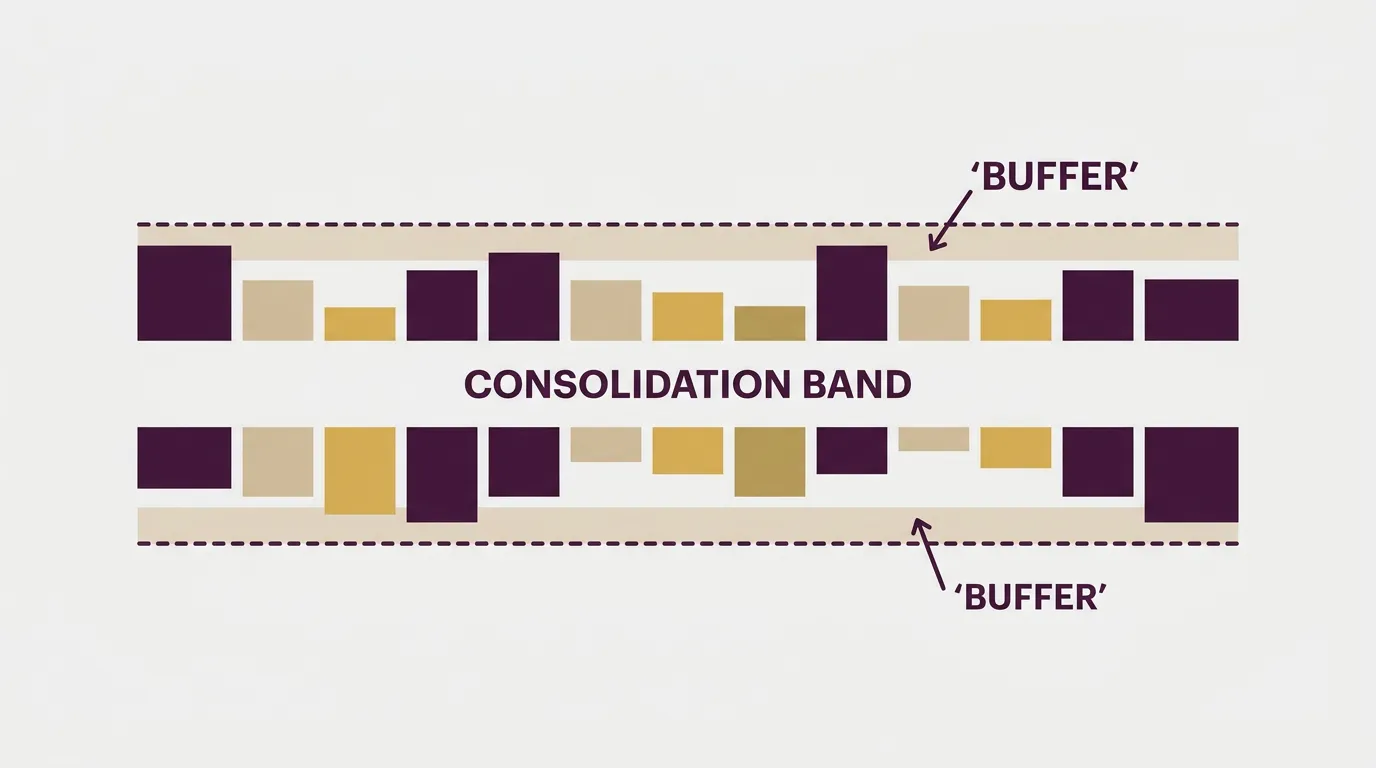
- Structure-anchored bounds. Use the highest high and lowest low of a clear consolidation window, then add a buffer so ordinary noise does not trip the exit. The buffer matters: a bound sitting exactly on an obvious swing high is where stop runs happen.
Then sanity-check the capital: total range width divided by your grid spacing gives the number of levels, and each level needs funding. If the bottom bound requires more capital than you allocated, the grid is too wide, the spacing is too tight, or the position size is too big. Tighten one of the three before you deploy. Spacing choices interact directly with this, which is covered in .
On Binance futures, an unbounded grid plus leverage means the exchange chooses your exit for you through liquidation. Spot grids can at least hold inventory. Futures grids cannot.
A stop that respects the grid's economics
The stop distance has to be paid for by grid profits. Rough logic: if your grid earns a small amount per completed round trip, and the break costs you the whole accumulated inventory loss, you need enough round trips before the break to come out ahead.
Practical guardrails:
- Place the stop beyond the bound, not at it. A stop sitting at the exact grid edge fires on the first overshoot that immediately reverses.
- Add a time-based exit. If the bot has held inventory near the lower bound for several days with no round trips, the range assumption is probably dead.
- Cap the total loss, not just the price. A acts as a second circuit breaker when a gap jumps past your price stop.
- Test the breakout scenario deliberately. Backtest across a period where the asset trended hard, not just the calm stretch that made the grid look good.
On algomax you describe all of this conversationally: the range, the number of levels, the stop behaviour, the daily loss cap. The assistant turns that into a bot you can backtest on historical candles before anything goes live.
Key takeaways
- Decide the edge behaviour (stop, pause, or recentre) before choosing bound levels.
- Anchor bounds to volatility or clear structure with a buffer, never to round numbers.
- Check that your bounds, spacing, and position size fit the capital you actually allocated.
- Backtest the grid through a strong trend, because that is the scenario that defines its worst case.
Frequently asked questions
Should a grid bot always have a stop loss?
Not always, but you must consciously choose. A grid without a stop is a commitment to hold inventory indefinitely if price leaves the range, which is only acceptable on spot with capital you are willing to tie up for a long time.
How wide should grid bounds be?
Wide enough that ordinary volatility does not breach them, narrow enough that your capital covers every level. Anchoring the bounds to a multiple of average true range or to a clear consolidation high and low with a buffer is more defensible than using round numbers.
Is it better to stop the grid or shift the range after a breakout?
Shifting the range chases the trend and can lock in repeated losses, while stopping realises one loss and frees your capital. Shifting only makes sense if you have independent evidence that the new price area is itself a range.
Why do grid bots look so good in backtests?
Because most backtest windows are chosen, consciously or not, from calm periods where the range held. Always test the same grid across a strong trending stretch to see its real worst case.
Can I build a bounded grid bot without coding?
Yes. On algomax you describe the range, level count, edge behaviour and loss limits in plain language, and the assistant turns that into a bot you can backtest before deploying through your own broker keys.