How to Describe a Trading Strategy in Plain Language
Learn how to describe a trading strategy in plain language so an AI can build a runnable no-code bot — entries, exits, risk, and the details to include.
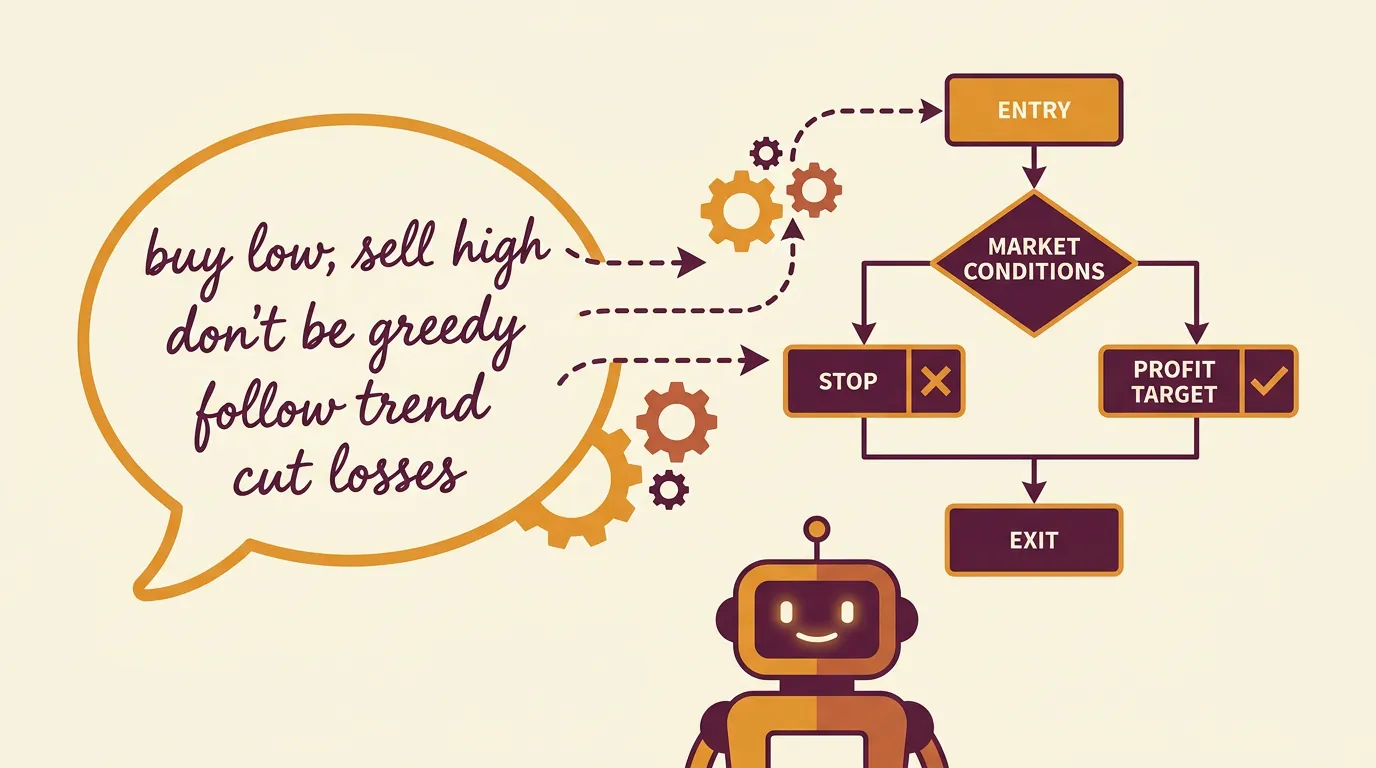
The skill that replaces coding
With an AI-built bot, you don't write code — you write a clear description. The quality of your bot depends almost entirely on how precisely you describe your idea. Vague input produces a vague bot; a well-structured description produces a strategy that does exactly what you meant.
The good news: you can describe it in your own words, in your native language, and the AI turns that into a ready-to-run bot. Your job is to be complete and specific.

The five things every description needs
A trading strategy is really just a set of rules. To build a bot, spell out all five of these — skipping one leaves the AI guessing.
- Market and side — Which asset (e.g. BTC on Binance, EUR/USD on OANDA)? Is it long-only or can it short?
- Entry condition — The exact trigger. "Buy when the 50-period EMA crosses above the 200-period EMA," not "buy when the trend turns up."
- Exit condition — When to close a winner. A target, an opposite signal, or a trailing rule.
- Risk controls — Your stop loss, position size, and any max-loss limit. This is the part beginners most often forget.
- Timeframe — 5-minute candles behave nothing like daily candles. Say which one.
Read your description back and ask: "Could a stranger follow these rules with zero interpretation?" If any step needs a judgment call, tighten it.
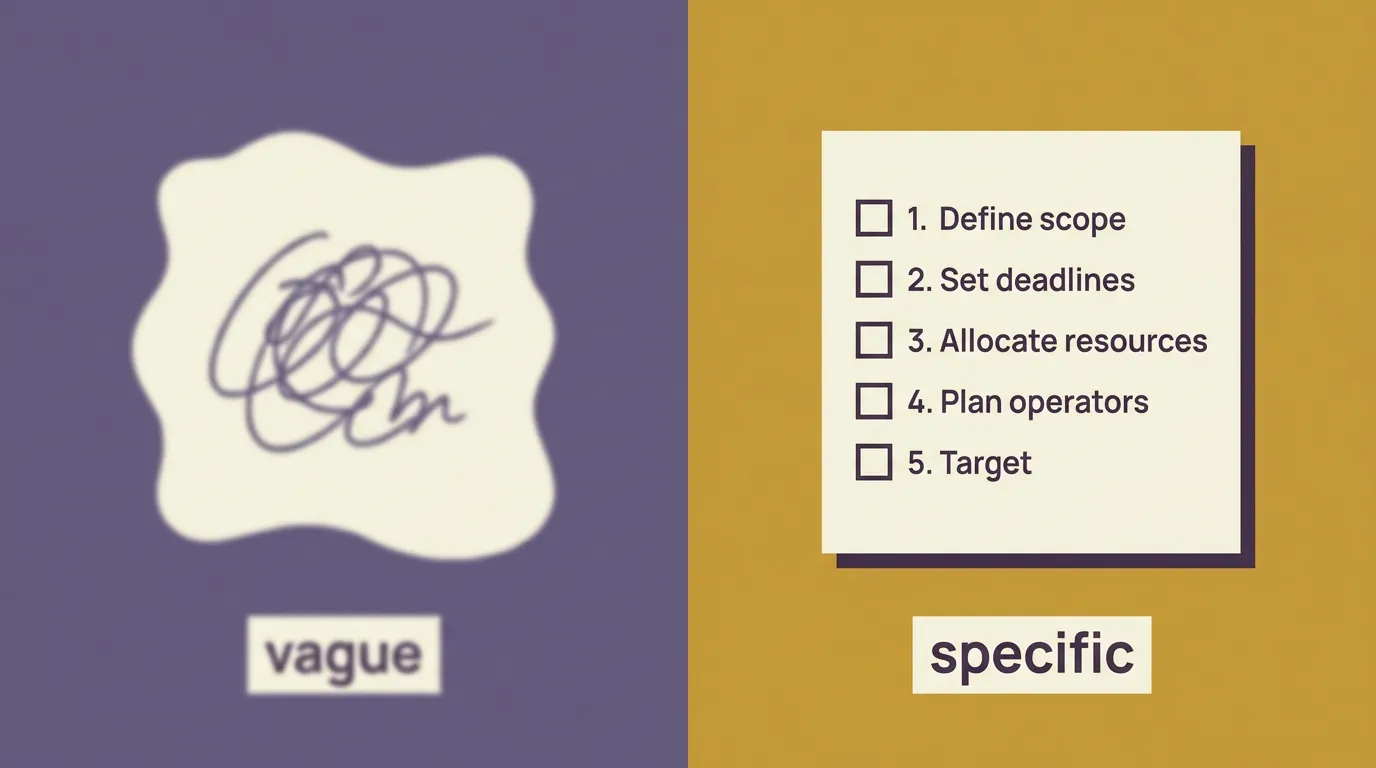
Vague vs. specific: a quick comparison
The difference between a description that works and one that doesn't is usually detail, not jargon.
Notice you don't need formulas or code — just plain rules with concrete numbers. Naming a common indicator like RSI or EMA is enough; the AI knows how to compute it.
Refine through conversation, then test
You rarely get it perfect on the first try, and that's fine. Building a bot is a conversation: describe the idea, see how the AI interprets it, then correct anything that's off. "Actually, only take the trade if volume is above average," or "make the stop trail instead of fixed."
Once the rules read the way you intended, don't go straight to real money. Check the logic on historical data first — to see how the rules would have behaved, then confirm on live prices with before committing capital.
A precise description is your edge in a no-code workflow. The AI handles the build; you own the thinking.
If you're stuck on what to write, start from a strategy you already understand on paper and translate it rule by rule. You can and adjust from there.
Key takeaways
- Detail beats jargon — concrete numbers and conditions matter more than fancy terms.
- Always cover market, side, entry, exit, risk, and timeframe — leaving one out forces the AI to guess.
- Treat it as a conversation: describe, review the interpretation, refine.
- Never skip backtesting and paper trading — a clear description isn't a promise of profit; trading is risky.
Frequently asked questions
Do I need to know any coding or formulas to describe a strategy?
No. You describe your rules in plain, conversational language — even in your native language — and the AI turns that into a runnable bot. You never write or see code or formulas.
What if my first description isn't quite right?
That's expected. Building a bot is a back-and-forth conversation: you review how the AI interpreted your idea and refine any rule that's off until it matches what you meant.
Do I have to name specific indicators like RSI or EMA?
Naming a common indicator helps because the AI knows how to compute it, but you don't have to. What matters most is describing the exact condition and the numbers, such as a threshold or percentage.
Once my description is turned into a bot, can I trust it with real money right away?
You shouldn't skip testing. Backtest the rules on historical data and run them in paper trading on live prices first. A clear description improves the bot's behavior but never guarantees profit — trading carries risk.