Binance Funding Rates: What Futures Bots Must Know
Binance funding rates quietly move your P&L on perpetual futures. Learn how they work, who pays whom, and how to build funding-aware crypto bots.
Funding rates, in one minute
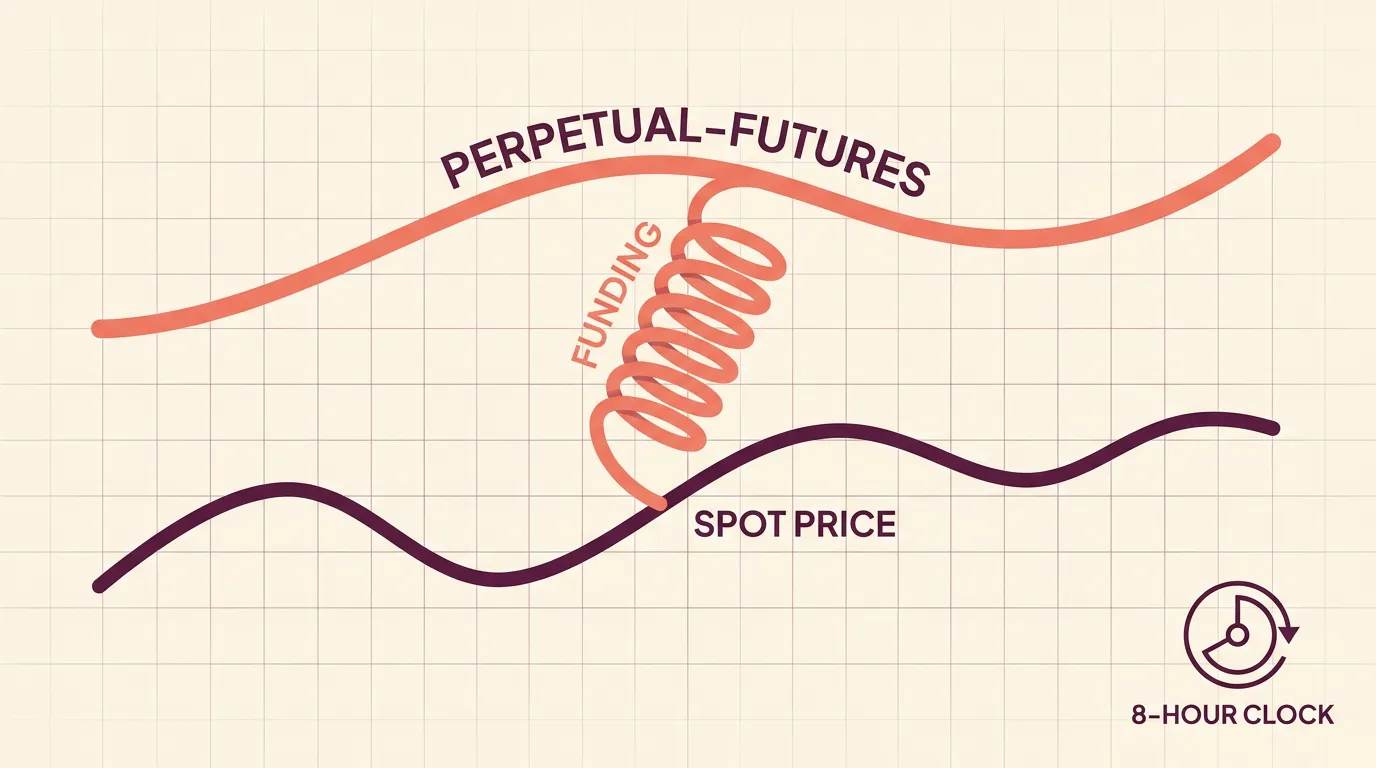
Binance perpetual futures never expire, so there's nothing forcing their price toward spot. The funding rate does that job. Every eight hours, longs and shorts pay each other a small fee based on how far the perpetual trades from the underlying spot price.
- Positive funding → the perp trades above spot → longs pay shorts.
- Negative funding → the perp trades below spot → shorts pay longs.
Binance settles this at 00:00, 08:00, and 16:00 UTC. If your position is closed before the timestamp, you pay nothing. If it's open, the rate hits your margin — win or lose on price.
Funding is not a trading fee. It's a peer-to-peer transfer between position holders, and it can quietly flip a break-even strategy into a losing one.
Why bots get caught out
The rate itself looks tiny — often around 0.01% per interval. But it compounds three times a day, and trend-following bots tend to sit on the crowded side of the trade, which is usually the side that pays.
A few ways funding sneaks up on automated strategies:
- Position-holding bots that stay in a winning long for days accrue funding every 8 hours.
- High-leverage futures magnify funding relative to your margin, not just your price P&L.
- Volatile regimes can push funding far above the baseline, sometimes to 0.1%+ per interval when one side is heavily crowded.
Backtests built on price candles alone ignore funding entirely. A futures strategy that looks profitable on paper can bleed out in live trading purely from funding costs.
Contrast this with spot trading, where you own the asset outright and there's no funding at all — a reason many beginners start there before touching perpetuals.
Building funding-aware bots
You don't need to fear funding — you need to account for it. Practical habits:
- Match holding period to strategy. A scalper that's flat within minutes rarely touches funding. A swing bot holding for days should treat funding as a real cost line.
- Prefer being on the paid side when it's extreme. Persistently negative funding pays shorts; that's a tailwind, not a reason to avoid the trade.
- Size for the true cost. When you calculate expected return per trade, subtract estimated funding for the expected holding time, then use volatility-based sizing so the position fits your risk. Our covers volatility-based stops and sizing.
- Cap downside regardless of source. A protects you whether losses come from price or from an ugly funding spike.
On algomax you describe these rules in plain language — "close the position before 16:00 UTC funding if it's in profit," say — and the AI turns that description into a ready-to-run bot on your own Binance keys. Because you , you can sanity-check a futures idea on historical candles first, then run it knowing funding is part of your plan, not a surprise.
Choosing spot or futures
If funding, shorting, and leverage feel like extra moving parts, that's a signal. Spot keeps things simple: no funding, no liquidation, no 8-hour clock. Futures unlock shorting and leverage — powerful, but they add funding and margin risk on top of ordinary market risk.
Test the same core idea on spot first. If it only works with high leverage on futures, the edge may be thin once funding and fees are counted.
Key takeaways
- Funding rate transfers value between longs and shorts every 8 hours on Binance perpetuals.
- Positive funding means longs pay; negative means shorts pay — trend-followers often sit on the paying side.
- Backtests on price alone miss funding; account for it in holding-period and sizing decisions.
- Spot has no funding — start there if leverage and margin risk aren't worth the complexity.
Frequently asked questions
How often does Binance charge funding on perpetual futures?
Binance settles funding three times a day, at 00:00, 08:00, and 16:00 UTC. You only pay or receive it if your position is open at that timestamp; if you're flat, you owe nothing.
Does spot trading on Binance have funding fees?
No. Funding applies only to perpetual futures. On spot you own the asset outright, so there's no funding rate — just ordinary trading fees.
Will a normal backtest include funding costs?
Usually not. Backtests built on price candles model price movement, not funding transfers. For a futures strategy you should factor estimated funding into expected return based on how long you hold positions.
Is negative funding good or bad for my bot?
It depends on your side. Negative funding means shorts get paid and longs pay, so a short position earns a small tailwind while it's held. Positive funding is the reverse.