Pips and Lots on OANDA: Sizing an Automated Forex Bot
Pips, lots and OANDA units explained for automated forex: how pip value works, why units beat lots for sizing, and how spread eats small targets.
What a pip actually is
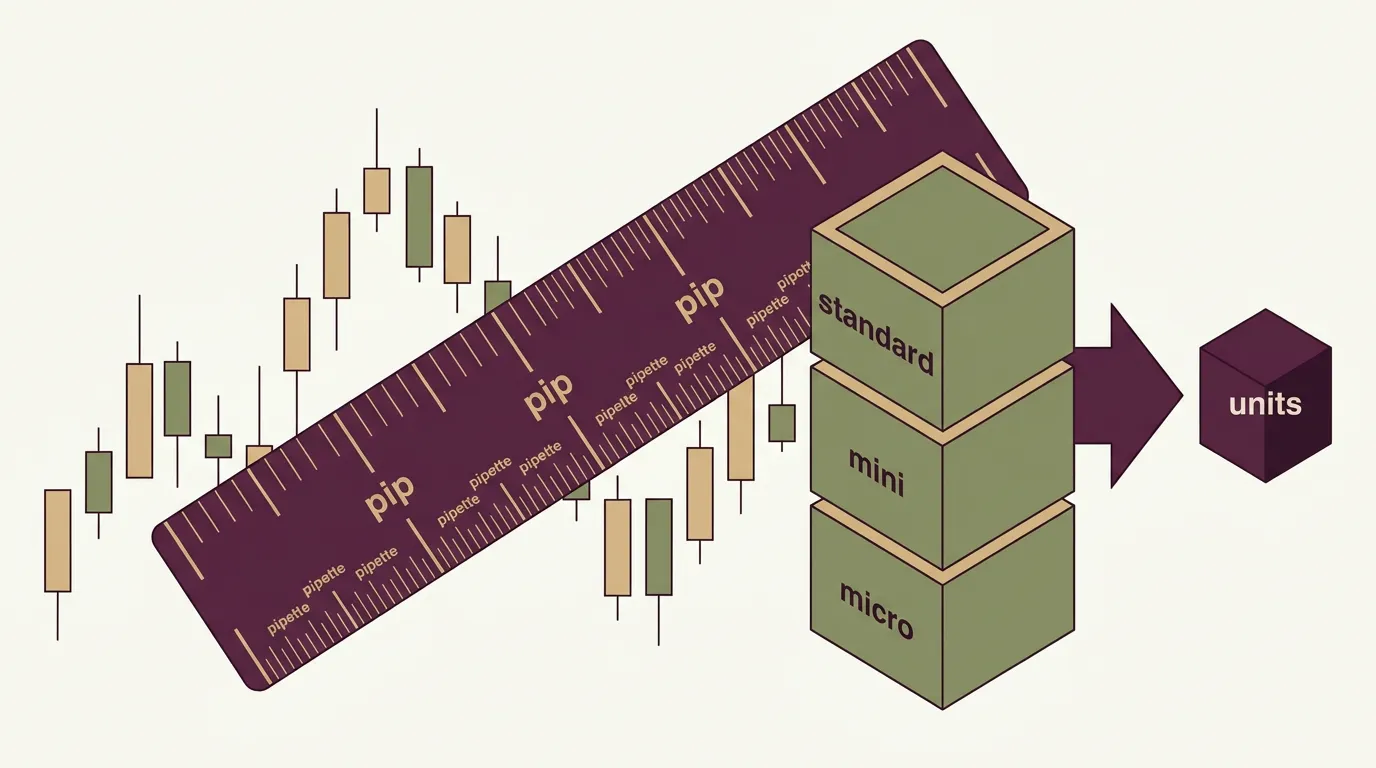
A pip is the standard price increment for a currency pair. For most pairs it is the fourth decimal place (0.0001). For yen pairs it is the second decimal (0.01). OANDA quotes a fifth decimal, the pipette, which is one tenth of a pip and mostly matters for measuring spread precisely.
Why this matters for automation: your bot thinks in pips when you talk about stops and targets, but your account is credited in your account currency. The bridge between the two is position size.
Units, not lots, on OANDA
Here is the practical part most beginners miss: OANDA lets you trade in arbitrary units, not fixed lot steps. You can hold 2,347 units of EUR/USD if that is what your risk math says. Lots are just convenient labels on top of units.
That flexibility is a gift for automated risk control. Instead of rounding your size up to the nearest mini lot and quietly taking 40% more risk than intended, your bot can size exactly to the stop distance. This is the same logic behind , applied to forex.
A rough guide to pip value on a pair quoted in USD, with a USD account:
- 1,000 units: about $0.10 per pip
- 10,000 units: about $1.00 per pip
- 100,000 units: about $10.00 per pip
For pairs where USD is the base rather than the quote (USD/JPY, USD/CAD), pip value moves with the exchange rate rather than sitting fixed. For crosses with no USD at all (EUR/GBP), a conversion step applies. You do not need to compute this by hand, but you do need to know that pip value is not constant across pairs.
A 20 pip stop is not a risk amount. It becomes one only after you multiply by pip value and units.
Turning risk into units
The chain your bot should follow, in plain terms:
- Decide the risk per trade as a percentage of account equity, for example 0.5%.
- Convert that to a currency amount (0.5% of a $10,000 account is $50).
- Take the stop distance in pips from your strategy logic, ideally volatility based rather than fixed.
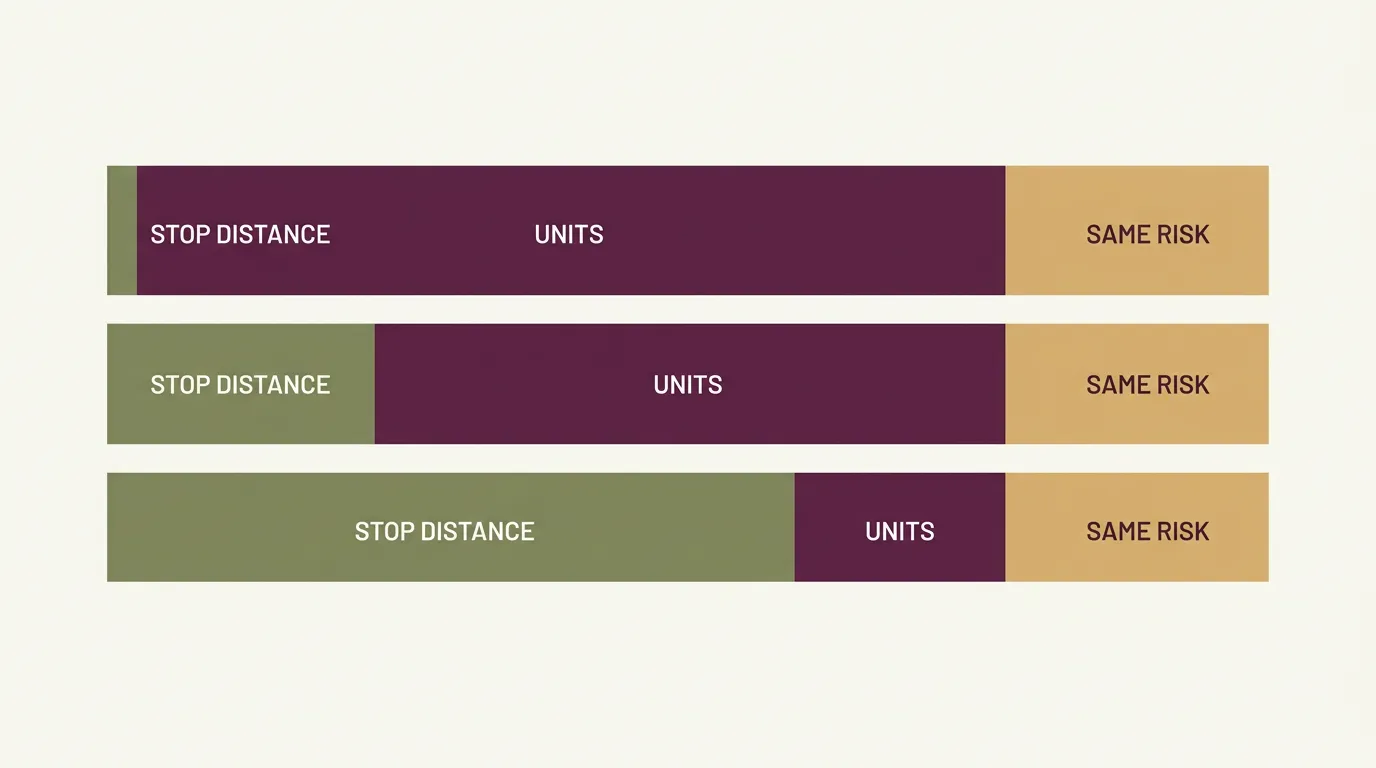
- Divide the risk amount by the per-unit pip value times the stop distance to get units.
A wider stop means fewer units. A tighter stop means more units. Risk stays flat, which is the entire point. Using keeps step three honest across calm and volatile sessions instead of forcing a fixed pip stop onto every regime.
Leverage does not change your risk per trade; your stop and size do. High leverage only means a small deposit can control a large position, which makes an oversized position easy to open by accident.
Spread and the pips you never see
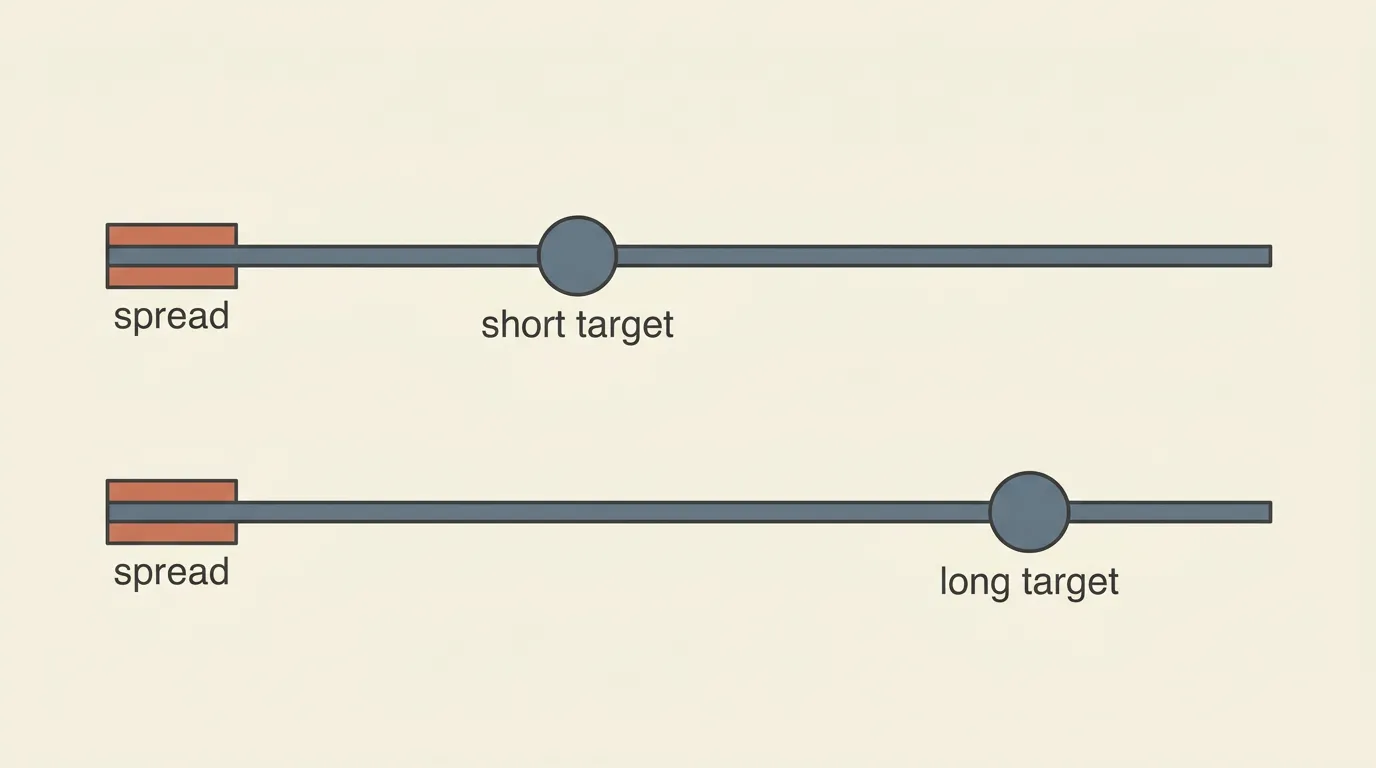
Every forex trade starts slightly underwater by the spread. On liquid majors in active hours that may be well under a pip. On exotics, or during thin liquidity around rollover, it can widen sharply.
Practical implications for a bot:
- A strategy targeting 5 pips with a 1.5 pip spread needs a far higher hit rate than the backtest suggests. Short-target scalping is the least spread-tolerant style there is.
- Spread is a real cost, so model it. Skipping it is the same error as .
- Overnight financing applies to positions held past rollover, which quietly favours intraday strategies over multi-day ones on small edges.
When you describe a strategy on algomax in plain language, you can state risk as a percent of equity and stops in pips or ATR multiples, and the assistant builds the sizing into the bot. Test it on historical candles before committing, using the .
Key takeaways
- A pip is 0.0001 on most pairs and 0.01 on yen pairs; pip value varies by pair and account currency.
- OANDA trades in units, so your bot can size precisely instead of rounding to lots.
- Size from risk percent and stop distance, never from a fixed lot habit.
- Include spread and financing in tests; tight-target strategies suffer most.
Frequently asked questions
What is the difference between a pip and a pipette?
A pip is the standard price increment, 0.0001 on most pairs and 0.01 on yen pairs. A pipette is one tenth of a pip, shown as an extra decimal place, and it mainly matters when measuring spread precisely.
Does OANDA require trading in fixed lot sizes?
No. OANDA lets you trade in arbitrary units rather than fixed lot steps, so a bot can size exactly to its risk calculation instead of rounding up to the nearest mini lot.
Is pip value the same on every currency pair?
No. Pip value depends on the quote currency, your account currency, and for some pairs the current exchange rate. Pairs quoted in your account currency have a stable pip value, while others move with the rate.
How does leverage affect risk per trade?
Leverage sets how much position a given deposit can control, not how much you lose on a trade. Your actual risk comes from position size multiplied by stop distance, so a disciplined stop matters more than the leverage number.
Should a backtest include forex spread?
Yes. Spread is a real cost paid on every trade, and strategies with small pip targets can look profitable in testing and lose money live purely because the spread was ignored.