Scaling Up Bot Size: How to Add Risk After Going Live
Scaling up a live trading bot too fast turns a small mistake into a big one. Learn a staged sizing ladder, the evidence to require, and when to scale back down.
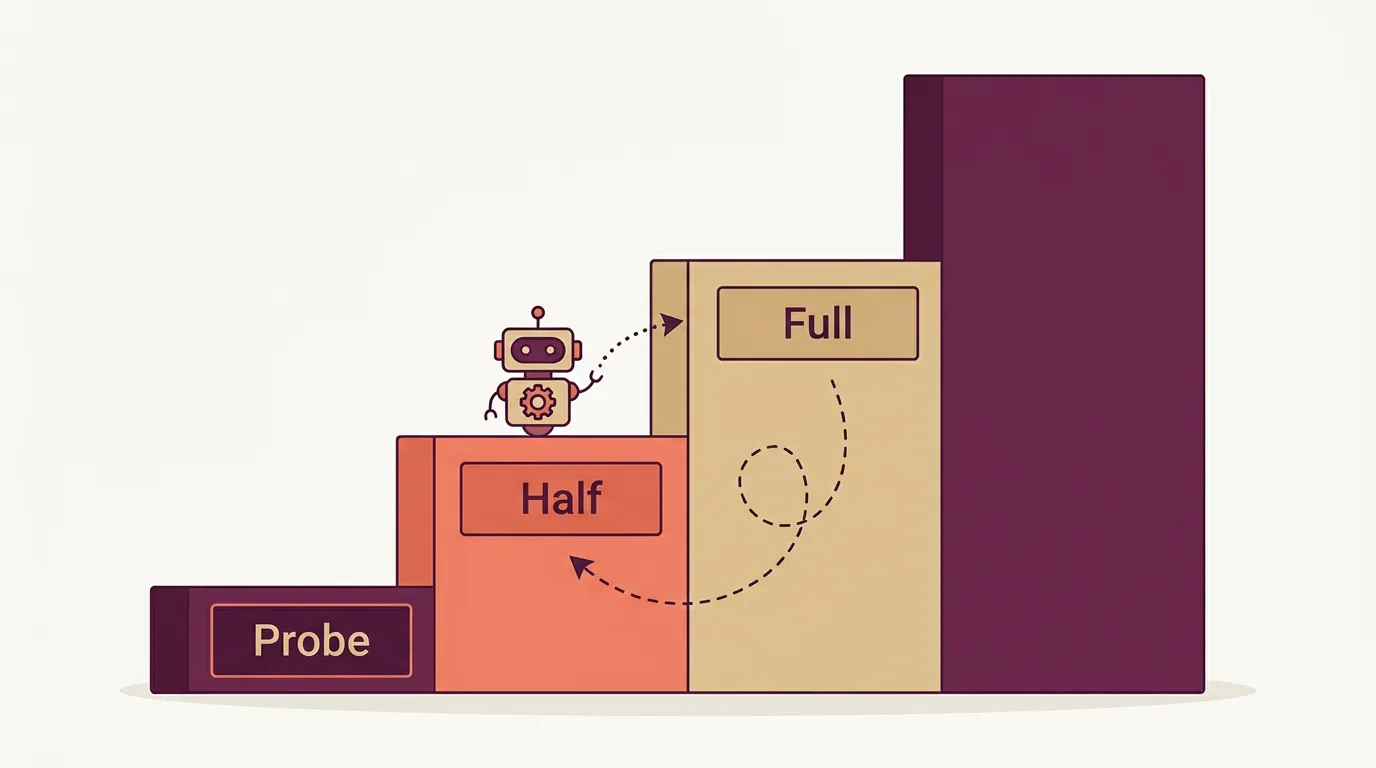
Start smaller than feels worthwhile
Most first live deployments fail not because the strategy was wrong but because the size was wrong on day one. A new bot should trade at a size where a worst-case week is annoying, not painful.
The point of small size is information, not income. Early live trading buys you data on slippage, fees, order fills, and your own tolerance for watching a drawdown in real money. You cannot get that from a backtest, and you cannot get it if the position is big enough to make you interfere.
The first weeks live are a paid experiment. Set the price of that experiment deliberately.
A practical starting point is roughly a quarter of the risk per trade you eventually intend to run. If your target is 1% of account equity risked per trade, start near 0.25%. Combine that with so the number scales cleanly as you step up.
A sizing ladder with evidence gates
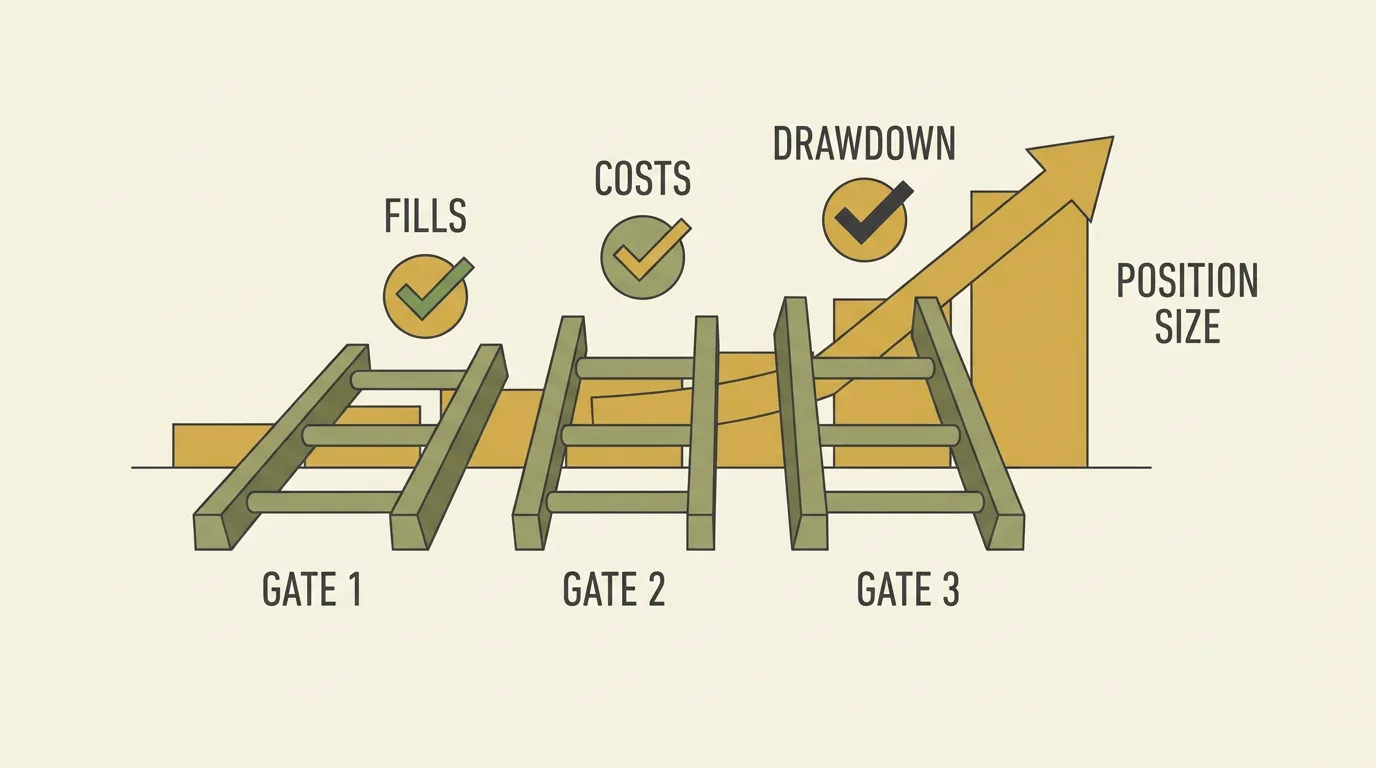
Do not increase size on a calendar. Increase it when the bot has produced enough live evidence to justify the next rung. A simple ladder:
The trade count matters more than the time elapsed. A bot that fires twice a month needs many months at the probe stage; a fast intraday bot may clear a rung in two weeks. Resist the urge to shortcut this because the early results look good.
What you are checking at each gate is not profit. It is whether live behaviour matches the model: are entries filling near the expected price, are fees eating a bigger share than assumed, are stops triggering where you expected? If are quietly doubling your cost per round trip, size up and you simply lose faster.
The mistakes that kill scaling plans
- Scaling on a win streak. Three good trades is noise. Raising size right after a hot run tends to place your largest positions right before mean reversion in results.
- Doubling instead of stepping. Jumping from 0.25% to 1% skips the rung where problems are still cheap to find.
- Scaling several bots at once. If your bots share a market or a direction, means portfolio risk grows faster than the per-bot number suggests. Step one bot at a time.
- Ignoring liquidity. A size that fills instantly on a probe may move the book on a thin pair or a small-cap stock. Watch fill quality, not just fill success.
Changing size mid-trade is not scaling, it is improvisation. Apply a new size to new positions only, so each stage produces clean, comparable results.
Know your scale-down rule before you scale up
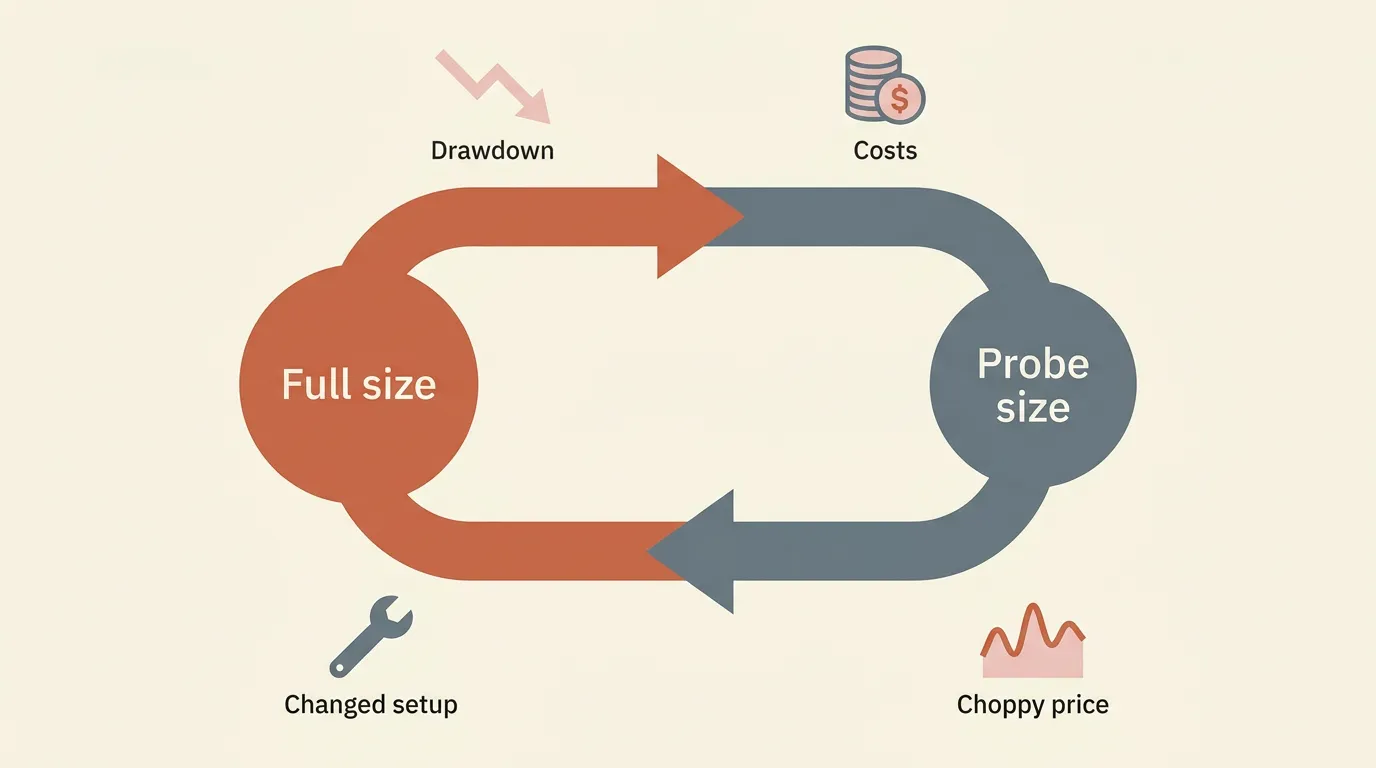
A ladder that only goes one direction is not a plan. Define, in writing, what sends the bot back a rung:
- Live drawdown exceeds the worst stretch seen in your out-of-sample test.
- Realised cost per trade drifts materially above backtest assumptions.
- The market regime the strategy depends on visibly changes, for example a trend bot in a sustained chop.
- Anything about the setup changes: new venue, new symbol, altered rules. Treat that as a fresh bot at probe size.
Pair the ladder with a hard so a single bad session cannot undo weeks of careful progress. On algomax you can describe both the sizing rule and the loss cap in plain language, and the assistant builds them into the bot, so stepping up is an edit rather than a rewrite.
Scaling up well is unglamorous: small steps, clear gates, honest comparison against expectations, and a willingness to go backwards. Nothing here guarantees a profitable outcome, but it does control how much a wrong assumption costs you.
Key takeaways
- Start at roughly a quarter of target risk; early live trading is for information.
- Move up on trade count and evidence, never on a calendar or a win streak.
- Step one bot at a time, and check fills and costs, not just profit.
- Write the scale-down rule before you write the scale-up plan.
Frequently asked questions
How many live trades before I increase a bot's size?
Think in trades rather than days. Around 20 live trades per stage gives a rough read on fills, costs and stop behaviour, though it is still a small sample and should not be treated as proof of edge.
Should I scale up after a winning streak?
No. A short run of wins is mostly noise, and raising size right after it tends to put your largest positions in place just as results normalise. Scale on evidence that live execution matches your assumptions instead.
Can I scale several bots up at the same time?
It is safer to step one bot at a time. If bots trade related markets or the same direction, your total portfolio risk grows faster than each individual size increase implies.
What if I change the strategy rules after going live?
Treat it as a new bot. Backtest the change, then restart at probe size, because the live evidence you collected applies to the old version, not the new one.
Does small live size make paper trading unnecessary?
No, they answer different questions. Paper trading checks logic and mechanics with no money at risk, while small live size reveals real fills, fees and your own reaction to a live drawdown.